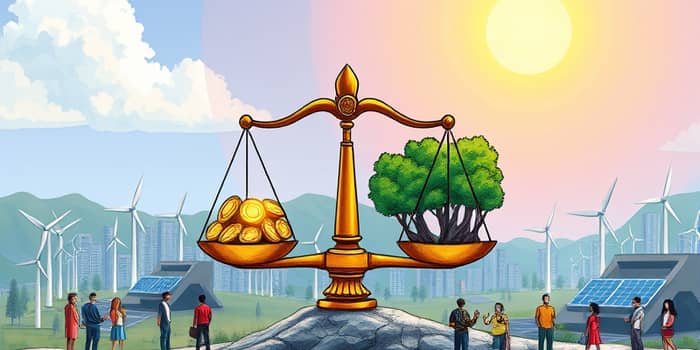
In today's financial world, environmental, social, and governance (ESG) considerations are no longer optional.
They form the backbone of a transformative approach that redefines value creation.
This shift is driven by the urgent need to address global challenges while securing long-term prosperity.
Sustainable finance merges profit with purpose, offering a pathway to balanced economic growth.
It supports projects like renewable energy and social inclusion, aligning with global goals such as the UN's Sustainable Development Goals.
Investors are increasingly recognizing that this isn't just about ethics; it's about smart, forward-thinking strategy.
Sustainable finance has evolved from a niche concept to a mainstream force.
It integrates ESG factors into every financial decision, from asset allocation to risk management.
This framework ensures that investments contribute to sustainable and balanced economic growth.
By focusing on long-term impacts, it helps mitigate risks like climate change and social inequality.
The approach is grounded in the belief that financial success and planetary health are interconnected.
ESG stands for environmental, social, and governance factors, each critical for holistic investing.
Environmental aspects include climate change mitigation and resource conservation.
Social factors cover human rights, diversity, and consumer protection.
Governance addresses management practices and ethical leadership.
Together, they provide a comprehensive lens for evaluating investments.
These pillars ensure that investments drive positive environmental and social outcomes.
The sustainable finance market is expanding at an unprecedented pace.
The sustainable bond market now exceeds $6 trillion, showcasing robust growth.
Biodiversity-linked bonds have surged, reflecting increased focus on nature-based solutions.
This growth is supported by regulatory changes and rising consumer demand.
These figures highlight the tangible scale of sustainable investing.
Multiple factors are accelerating the adoption of sustainable finance.
Awareness of environmental crises and social issues is growing globally.
Regulatory frameworks are evolving to mandate ESG integration.
Economic costs from climate risks are becoming more apparent.
These drivers ensure that sustainable finance is here to stay.
The future of sustainable finance is bright with emerging trends.
Energy transition investments are accelerating, especially in renewables.
Water finance is gaining traction as risks from scarcity increase.
Transition finance will guide high-emitting sectors toward sustainability.
These trends signal a move toward greater pragmatism and impact.
Sustainable finance offers diverse products that cater to various investor needs.
These tools explicitly factor in ESG criteria for measurable impact.
They contrast with traditional instruments by linking performance to sustainability targets.
Such products enable investors to align their portfolios with their values.
Ignoring sustainable finance means missing out on significant opportunities.
It drives innovation and enhances corporate reputation over time.
Investors benefit from mitigated risks and improved financial performance.
Board members are increasingly focused on ESG developments for strategic planning.
This integration is becoming part of fiduciary duty, ensuring long-term value creation.
By adopting sustainable practices, investors can future-proof their assets against volatility.
Sustainable investing faces hurdles that require thoughtful navigation.
Political backlash and uneven policy progress can create uncertainty.
Data gaps in areas like biodiversity complicate measurement efforts.
The industry is shifting toward realism, emphasizing tangible impact over theory.
Public-private partnerships (PPPs) are crucial for scaling sustainable finance.
They involve structured cooperation and joint investment in impactful projects.
PPPs feature risk-sharing mechanisms and long-term commitments to outcomes.
These efforts amplify impact and drive systemic change across markets.
Sustainable finance is entering a phase of recalibration and maturation.
It demonstrates tangible value and drives innovation across sectors.
The focus is on energy transition, biodiversity, and climate adaptation.
ESG integration is increasingly seen as material to financial returns.
Investors who embrace this approach will lead in the new economy.
By prioritizing sustainability, markets can build a resilient and inclusive future for all.
References