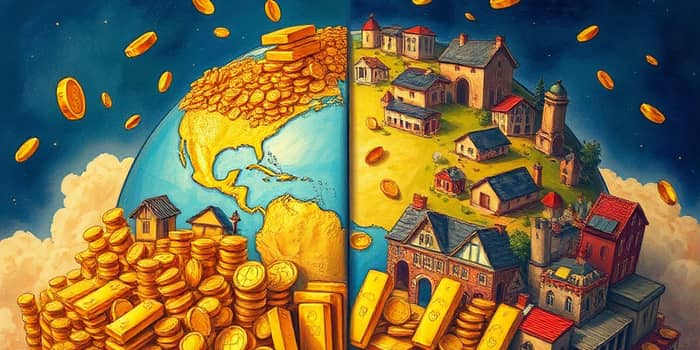
In an era where fortunes skyrocket and many struggle to meet basic needs, understanding the mechanisms behind extreme wealth concentration has never been more urgent. This article dives deep into global and U.S. inequality, revealing the forces shaping modern affluence—and what we can do about it.
The gap between those at the very top and the rest of the world has reached staggering proportions. As of 2025, the wealth held by the world’s richest has surged, leaving billions with only a fraction of global resources.
This staggering concentration of global wealth undermines social cohesion and threatens democratic norms, as power consolidates in the hands of a tiny elite.
In the U.S., wealth inequality mirrors and amplifies global trends. A combination of asset appreciation, tax policies, and uneven wage growth fuels a widening divide.
By Q3 2025, the top 1% of U.S. households controlled 31.7% of national wealth—equal to the bottom 90%. Such billionaire fortunes outpacing national GDPs highlight systemic imbalances built over decades.
Tracing the trajectory of inequality reveals how policy choices and economic shifts have shaped today’s landscape.
Over thirty years, the wealth Gini coefficient rose to approximately 0.75. The acceleration since the 1990s—driven by financialization and globalization—has uncovered underlying systems that perpetuate unfair advantage.
While the extremes of wealth concentrate everywhere, regional averages vary dramatically.
North America and Oceania boast the highest per-adult wealth—338% above the world average—while Sub-Saharan Africa lags at just 20% of that benchmark. In every region, the top 1% outstrips the bottom 90%, and the top 10% controls more than half of all assets.
Such disparities are compounded by cross-border capital flows. Each year, roughly 1% of global GDP shifts from poorer to richer nations via debt servicing and profit repatriation, further entrenching inequality.
The immense gulf between the ultra-rich and the rest of humanity has profound social, political, and moral consequences. Hunger afflicts 733 million people, 2.8 billion cannot afford a healthy diet, and over 115 million are displaced annually—outcomes directly linked to wealth concentration.
By spotlighting these power asymmetries that challenge democratic ideals, we can begin to envision a future where prosperity is shared more broadly. Addressing systemic imbalances requires collective will and bold policymaking.
Ultimately, dissecting the secrets of affluence means not only exposing the figures and trends but also empowering communities to advocate for fairness. When we understand how wealth is accumulated and preserved, we unlock the potential to reshape economies in service of the many rather than the few.
References