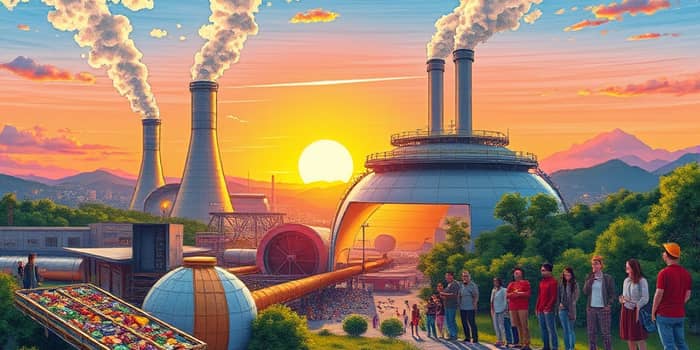
Across the globe, communities face a growing mountain of waste and an urgent need for sustainable energy. Waste-to-energy (WtE) projects offer a transformative answer, converting discarded materials into power that fuels homes, businesses, and industries. This narrative is one of ingenuity, collaboration, and hope, showing how cities can harness technology to close resource loops and fight climate change.
As landfills expand and environmental pressures intensify, innovative solutions become essential. In weaving together data, anecdotes, and practical insights, we explore how the WtE sector is evolving and how individuals, companies, and governments can support this remarkable journey.
Imagine waking in a city where garbage trucks deliver refuse not to landfills but to gleaming energy plants. Behind every light switch flick, there is a story of transformation: plastic packaging, paper scraps, and organic leftovers fueling turbines that hum with clean power. This vision is becoming reality through relentless innovation and cross-sector collaboration.
The global waste-to-energy market expansion has attracted significant investment and attention. Valued between USD 42.4 billion and USD 48.06 billion in 2024, analysts forecast a surge to between USD 77.3 billion and USD 92.95 billion by the early 2030s. Sustained growth rates of 6.6% to 6.81% CAGR reflect rising demand for clean energy solutions and effective waste management.
Today, more than 2,800 WtE plants operated globally with a combined disposal capacity of 576 million tons per year. Projections anticipate about 3,100 plants processing over 700 million tons annually by 2033. This increase highlights both the scale of the waste challenge and the appetite for innovative, circular strategies.
Regional markets vary widely, each offering lessons and case studies:
The leadership in Asia-Pacific driven by China is undeniable: over 400 plants in China alone process 400,000 tons daily, with capacity set to exceed 700,000 tons per day by 2025. In North America, 76 facilities convert nearly 94,000 tons of municipal solid waste daily into 2.5 GW of electricity. In Europe, mature WtE infrastructure powers tens of millions of residents with both heat and power.
Pioneers like Veolia and SUEZ demonstrate real-world impact. Veolia processes over 14 million tonnes of landfill waste and generates more than 1.2 million MWh of electricity annually. Its Istanbul plant alone handles 1.1 million tonnes per year, powering an 85 MW turbine that produces 560,000 MWh and avoids 1.5 million tonnes of CO₂ emissions.
SUEZ’s Créteil plant in Paris exemplifies innovation, processing 345,000 tonnes of waste to produce green electricity, district heat, and hydrogen for local fleets. Integrated greenhouses use waste heat to cultivate tomatoes, and upcoming expansions will add direct hydrogen production, avoiding 1,500 tonnes of CO₂ annually.
At its heart, the WtE revolution is about preventing methane emissions with technology. Landfill disposal generates methane, a greenhouse gas 84 times more potent than CO₂ over 20 years, whereas controlled combustion in WtE facilities captures energy and significantly cuts emissions.
According to the IPCC, facilities equipped with advanced emission controls can produce clean electricity and cut GHG emissions, with each ton of MSW processed avoiding approximately one ton of CO₂ equivalent. In California, three thermal WtE plants achieve net negative emissions compared to landfill scenarios.
Beyond reducing greenhouse gases, WtE plants recover metals and minerals from ash, feeding materials back into manufacturing and strengthening the circular economy approach. In Copenhagen, three plants meet half of the city’s heating needs and avoid 800,000 tons of CO₂ every year.
Innovation in WtE is rapid and multifaceted, spanning improved combustion efficiency, flue gas cleaning, carbon capture integration, and emerging hydrogen production. SUEZ and other leaders are retrofitting existing plants to boost electrical efficiency and pilot CO₂ capture systems.
In Uzbekistan, a USD 1.3 billion investment will build eight WtE facilities across 11 regions, processing 4.7 million tonnes of waste yearly and generating 2.1 billion kWh by 2027. This project underscores how governments can drive transformative change through policy and investment.
The sector is also exploring integrated resource recovery models for maximum value, blending recycling, energy conversion, and emissions control to create a true circular economy. As hydrogen gains momentum, WtE plants could become hubs for renewable fuel production, closing gaps in decarbonizing heavy industry and transport.
Despite its promise, WtE faces hurdles including high capital costs, public perception concerns, and regulatory complexities. Building trust requires transparent emissions reporting, community engagement, and robust environmental safeguards.
Successful projects emphasize dialogue and collaboration, demonstrating that modern WtE plants are far from the smoky stigmas of the past. By highlighting health-safe emissions (often 70% below regulatory limits), developers can shift narratives and build public support.
Individuals can champion waste-to-energy efforts by improving recycling habits, supporting local initiatives, volunteering at community clean-up drives, and engaging with policymakers to encourage WtE adoption. Businesses can adopt circular principles, reducing waste and exploring partnerships with energy-from-waste facilities.
Governments should streamline permitting processes, offer financial incentives, and integrate WtE into broader sustainability frameworks. By setting clear targets and investing in research and development, policymakers can unlock the sector’s full potential and foster resilient, net-zero cities.
Waste-to-energy projects embody a profound vision: transforming society’s leftovers into sustainable power. From towering plants in Asia-Pacific to sleek facilities in Europe and North America, these systems illustrate human ingenuity at its best. By converging industry leadership, technological advances, and collaborative policy, we can turn the tide on waste, protect our climate, and illuminate a greener future.
Every ton of trash processed, every kWh generated, and every community empowered brings us closer to a world where nothing is wasted, and energy flows from the most unexpected sources. The journey demands that each of us rethink waste as a resource and step forward as active participants in crafting a cleaner, healthier planet for generations to come.
References