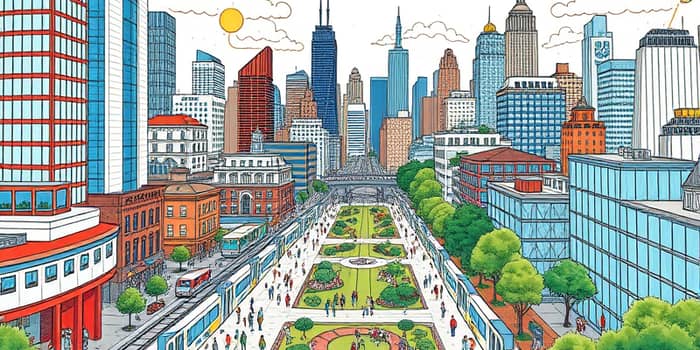
Urban economics examines how economic activity shapes cities and how cities, in turn, influence economic outcomes. It uses rigorous tools and models to explore urban growth, resource allocation, and policy interventions. By understanding these dynamics, stakeholders can craft strategies that enhance prosperity while mitigating pressing issues.
In this article, we delve into the fundamental concepts, drivers of success, key challenges, and practical policy responses. Our goal is to inspire data-driven urban transformations and equip readers with actionable insights.
At its core, urban economics applies microeconomic analysis to the spatial organization of households, firms, and governments within a city. This field addresses questions such as: Why do cities emerge? What determines land values across neighborhoods? How do transportation networks affect firm locations?
Key principles include microeconomic tools to analyze land use decisions, allocation for residential and commercial purposes, and the interplay between public infrastructure and private investment. Location theory explains why firms cluster in central business districts, while households trade off commuting costs against housing prices.
Classic models—like the monocentric city framework and bid-rent theory—describe how rents decline with distance from a central hub. More recent approaches incorporate economies of scale and imperfect competition, capturing the complexity of modern megacities.
Cities thrive when they harness certain foundational elements. Understanding these drivers helps policymakers and business leaders foster sustainable growth.
When these factors align, cities become dynamic marketplaces for ideas, attracting entrepreneurs and investors. High-density environments lower transaction costs and accelerate productivity gains, giving rise to global hubs of commerce and culture.
Despite their potential, urban areas also grapple with significant issues that threaten equity, sustainability, and quality of life.
These challenges are interconnected. For example, sprawl increases commute times, which in turn raises emissions and reduces productivity. Similarly, housing shortages concentrate low-income residents in under-resourced neighborhoods, perpetuating inequality.
Addressing urban challenges requires a blend of holistic public policy approaches and community engagement. Below are core strategies that cities worldwide have employed with success.
First, transit-oriented development prioritizes high-density housing and commercial spaces near public transport hubs. This approach reduces car dependency, curbs sprawl, and makes commuting more efficient. Implementing detailed infrastructure investment strategies—such as bus rapid transit systems and protected bike lanes—can transform mobility patterns.
Second, zoning reforms and streamlined permitting processes can unlock housing supply, lowering costs while preserving neighborhood character. Inclusionary zoning, for instance, mandates that new developments include affordable units, fostering socioeconomic integration.
Third, targeted fiscal policies—like value capture financing—enable cities to reinvest infrastructure gains into underserved areas. By tapping into land-value increases around new transit lines, municipalities can fund parks, schools, and social services.
Finally, sustainability initiatives rooted in the urban metabolism framework assess resource flows and waste streams. Cities adopting circular economy principles reduce emissions and bolster resilience. Planting urban forests, retrofitting buildings for energy efficiency, and investing in green infrastructure exemplify balanced growth and sustainable development.
Urban economics offers a powerful lens for understanding how cities succeed and struggle. By analyzing land use patterns, transportation networks, market forces, and policy interventions, stakeholders gain the tools to shape thriving, equitable communities.
We stand at a pivotal moment: rising urban populations demand innovative solutions to long-standing challenges. Embracing data-driven decision-making, fostering inclusive growth, and prioritizing environmental stewardship will define the next generation of global cities.
As you apply these insights to your own city or neighborhood, remember that thoughtful collaboration among government, private sector, and residents is key. Together, we can unlock the full potential of our urban ecosystems and build a future where prosperity and well-being go hand in hand.
References