In a world where economic stability often feels elusive, understanding unemployment is more than a statistic; it's a key to personal empowerment and global progress.
The global unemployment rate is projected to remain at 4.9% in 2026, a figure that conceals profound labor market challenges.
This article unravels the main types of unemployment, providing a roadmap for job seekers, policymakers, and anyone seeking clarity in turbulent times.
By exploring these concepts, we can transform fear into foresight and uncertainty into opportunity.
Beneath the surface of stable numbers lies a reality of struggle and aspiration.
The global jobs gap is expected to reach 408 million people by 2026, highlighting those who desire work but face barriers.
This gap reflects systemic issues, from inadequate skills training to economic disparities.
These facts underscore that unemployment is not just about numbers but human potential.
Addressing it requires a nuanced understanding of its various forms.
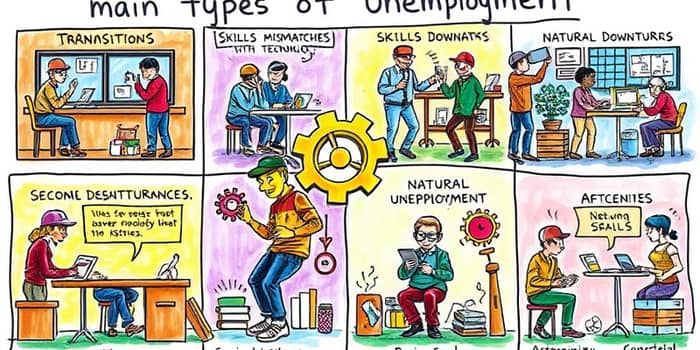
Frictional unemployment refers to temporary unemployment during job transitions, a healthy sign of labor market mobility.
It occurs when workers seek better opportunities or employers search for the right fit.
This type is often short-term and voluntary, indicating economic dynamism rather than distress.
Embracing frictional unemployment can lead to better career matches and personal growth.
It encourages continuous learning and adaptability in a fast-changing world.
Structural unemployment arises when job seekers' skills don't align with available jobs, driven by technological or industrial shifts.
This type is often involuntary, stemming from economic transformations beyond individual control.
It highlights the need for lifelong learning and reskilling initiatives.
The consequences can be severe, leading to long-term unemployment if not managed.
Investing in skills development is crucial for mitigating structural challenges.
Cyclical unemployment increases during economic downturns or recessions, affecting multiple sectors simultaneously.
When consumer demand drops, businesses reduce staff, creating a ripple effect of job losses.
This type is closely tied to broader economic health and policy interventions.
Building financial resilience and diversifying skills can buffer against cyclical impacts.
It reminds us that economies are interconnected and responsive to change.
Natural unemployment combines frictional and structural unemployment, representing the lowest sustainable unemployment level without causing inflation.
It is ever-present in thriving economies, reflecting voluntary job searches and evolving skill demands.
Economists generally agree that a healthy rate ranges between 4 and 6 percent.
It underscores the balance between job creation and economic stability.
Embracing this concept fosters a more nuanced view of labor market health.
Long-term unemployment, defined as unemployment for 27 weeks or more, poses significant risks to individuals and economies.
It can perpetuate poverty cycles and reduce future employability through skill erosion.
Underemployment includes visible forms, like part-time workers wanting full-time hours, and invisible forms, such as overqualified employees in low-skill jobs.
Discouraged workers, who stop seeking employment, are often excluded from statistics but signal deeper societal issues.
Understanding these nuances can lead to more effective personal and policy responses.
The U.S. Bureau of Labor Statistics provides six measures to capture unemployment's full spectrum.
This framework helps policymakers and analysts assess labor market health more accurately.
It reveals that unemployment is multifaceted, requiring diverse solutions.
The broadest distinction lies between voluntary and involuntary unemployment, shaping individual experiences and support needs.
Voluntary unemployment involves people leaving jobs by choice, often for better opportunities.
Involuntary unemployment includes those fired or laid off, facing urgent financial pressures.
This categorization fosters empathy and practical action in addressing unemployment.
Youth unemployment rates are rising, with 260 million young people classified as NEET (Not in Education, Employment, or Training).
The gender gap persists, with women facing higher job gaps and comprising only 40% of global employment.
Regional variations show higher informality in African and Southern Asia regions.
These disparities demand inclusive policies that address specific barriers.
Empowering vulnerable groups can drive broader economic resilience and growth.
Trade generates around 465 million jobs worldwide, but disruptions can lead to wage losses and unemployment spikes.
Supply chain bottlenecks, for example, affect workers in regions like Southeast Asia and Europe.
This interconnection underscores the need for stable trade policies and economic diversification.
By fostering robust trade networks, economies can create more resilient job markets.
It reminds us that unemployment solutions must be global in scope yet local in application.
All four main types of unemployment are interconnected, shaping dynamic labor markets.
Complete elimination is neither possible nor desirable in healthy economies.
Multifaceted approaches are essential, blending education, policy, and personal initiative.
By understanding these types, individuals can navigate career changes with confidence.
Policymakers can craft strategies that address both unemployment rates and job quality.
This knowledge empowers us to build a more inclusive and adaptive future.
References