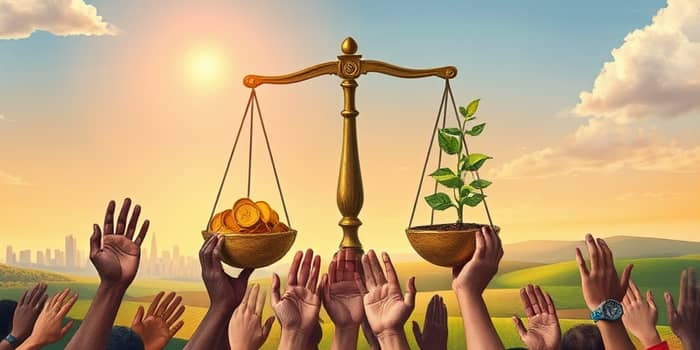
In an era of unprecedented economic advancement, millions of people enjoy the benefits of global trade and innovation. Yet behind this progress lies a stark reality: the promise of shared prosperity remains unfulfilled for vast swaths of humanity.
Today, extreme global wealth inequality shapes our world, creating barriers to opportunity and deepening social divides. The concentration of resources at the top threatens the well-being and stability of communities everywhere.
Global statistics reveal a dramatic imbalance: the top 10% own roughly 75% of global wealth, while the bottom 50% hold only 2%. Income disparities mirror this trend, with the world’s richest tenth capturing 53% of all earnings, compared to just 8% for the poorest half.
Since the 1980s, the pace of wealth accumulation at the summit has accelerated. Billionaires' wealth grew 8% annually over the past three decades, more than twice the rate of the bottom half. By 2025, the assets of the top 0.001% will exceed those of the entire bottom 50% combined.
These numbers are not abstract; they represent real people denied access to education, healthcare, and the dream of homeownership. As inequality deepens, social cohesion frays, and the risk of instability rises.
Multiple forces fuel these disparities. Understanding their interplay is crucial to reversing the trend.
Inequality exists on every continent, but its manifestations vary. In Europe, the richest decile holds 200 times the wealth of the poorest half. In North America and Oceania, that gap exceeds 520 to one. Sub-Saharan Africa and Latin America face ratios above 260 to one.
In the United States, the divide has reached a three-decade high. By the third quarter of 2025, the top 1% held 31.7% of wealth—a share matching the combined holdings of the bottom 90%. Post-pandemic recoveries favored high-income earners, while wage growth for low- and middle-income workers languished.
Such extremes undermine economic mobility and erode trust in institutions. When large portions of the population struggle under debt burdens and wage stagnation, the social contract frays.
Evidence-based policies can narrow gaps without stifling growth. Thoughtful combinations of redistribution, investment in human capital, and structural reforms offer a path forward.
Additional measures—universal healthcare, affordable housing initiatives, and support for small businesses—address both symptoms and root causes. When governments invest in people and ensure fair rules, everyone benefits.
Bridging the wealth divide requires concerted effort from individuals, communities, and policymakers alike. Here’s how you can help:
Each action, no matter how small, contributes to a broader momentum for change. By lifting up our neighbors and demanding an economy that works for all, we lay the foundation for a more just and prosperous society.
Ultimately, closing the wealth gap is not only a matter of numbers—it is a moral imperative and a strategic investment in our collective future. The choices we make today will shape the world we pass on to generations to come.
References