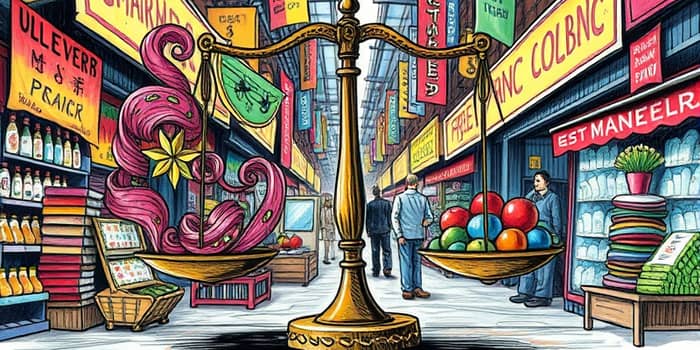
In an ideal world, markets hum along perfectly, resources flow to their highest-value uses, and every economic agent thrives without intervention. Yet reality is more tangled, littered with monopolies, externalities, taxes, and information gaps. The theory of the second best reveals that when one ideal condition breaks down, pursuing all remaining optimal rules may not restore efficiency. Instead, sometimes introducing additional distortions can sometimes counteract existing ones, nudging the system closer to a true optimum.
The concept emerged in 1956 when economists Richard Lipsey and Kelvin Lancaster published "The General Theory of the Second Best." They studied constrained general equilibrium models and discovered a surprise: if a single Pareto condition fails, holding the others constant does not guarantee the best possible outcome. In fact, deviating from some first-best rules could increase overall welfare.
This insight challenges the textbook ideal of a frictionless market, known as the first-best equilibrium or economic nirvana. In that state, firms set price equal to marginal cost, consumers’ marginal rates of substitution align perfectly with price ratios, and supply equals demand in every market. Any violation—be it a monopoly charging a markup or a tax that distorts labor supply—breaks the chain of optimality.
First-best conditions require:
When any one of these conditions is unattainable, the equilibrium shifts. The second-best equilibrium arises when imperfections—like externalities or monopolies—cannot be corrected directly. Under those constraints, the remaining conditions must adjust, often in counterintuitive ways.
Traditional welfare economics teaches that correcting a distortion is always beneficial. The second-best theorem warns that if some distortions cannot be fixed, the effect of correcting others becomes ambiguous. Policymakers must analyze the entire system rather than apply one-size-fits-all rules.
In multi-distortion settings, adding a policy lever may inadvertently improve welfare. For instance, a carefully calibrated tariff might offset the market power of a foreign monopoly—an arguably perverse but valuable outcome.
A numerical example highlights the paradox of fixing only one distortion. Suppose domestic producers already receive an export subsidy. Introducing free trade, without removing the subsidy, seems by itself welfare-enhancing. Yet the subsidy’s cost may swamp the gains, yielding a net welfare loss.
Consider this summary of changes before and after a $4-per-unit export subsidy:
This table demonstrates that without removing the underlying subsidy, free trade alone worsens total surplus.
Economists and policymakers often confront multi-layered distortions:
Even modern debates—over environmental regulation, financial oversight, and healthcare interventions—echo the doctrine. President Biden’s economic agenda, for example, grapples with entrenched market failures where every policy shift interacts with dozens of existing distortions.
The second-best theorem carries a humbling message: optimal policy is laissez-faire or free trade only in the absence of any imperfections. Once distortions creep in, blindly applying textbook rules can backfire. Economists must map the full distortion landscape and, if necessary, embrace measures that appear suboptimal in isolation but enhance system-wide welfare.
This perspective fosters policy humility and nuanced analysis, reminding us that real-world economies do not neatly separate market failures. Each intervention ripples through the web of existing distortions, often in surprising ways.
The theory of the second best does more than refine academic models; it reshapes our approach to governance. It encourages policymakers to look beyond single-issue fixes, to weigh the interplay of taxes, subsidies, regulations, and market structures. By acknowledging that every economy operates under constraints, we open the door to creative, sometimes paradoxical, solutions that edge us closer to true efficiency.
Ultimately, the second-best framework is a call to embrace complexity, to recognize that adding a well-placed distortion might just be the very cure an imperfect system needs.
References