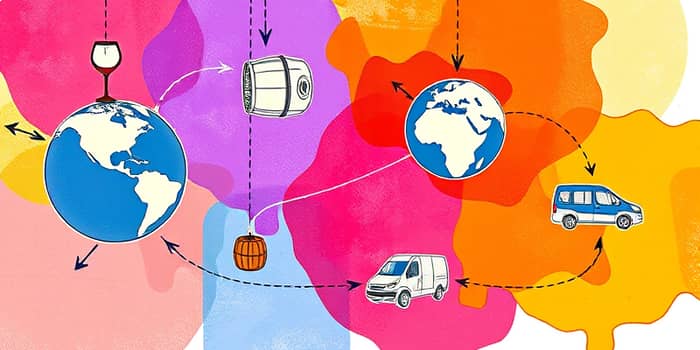
Imagine a world where every nation, no matter its resources or skills, can thrive through cooperation.
This vision is made possible by a foundational economic principle that has shaped global prosperity for centuries.
At its heart lies the idea of comparative advantage, a concept developed by David Ricardo in 1817.
It explains why countries engage in trade even when one might seem more efficient in all production areas.
By focusing on lower opportunity costs, nations can specialize and create win-win scenarios for all involved.
This theory is not just an abstract idea; it drives real-world policies and personal economic decisions today.
Understanding it can illuminate paths to greater efficiency and shared growth in our interconnected world.
Before David Ricardo, Adam Smith introduced the concept of absolute advantage in 1776.
Smith argued that countries should produce goods where they have a cost edge.
Ricardo built upon this by solving a puzzling economic dilemma.
He showed that even without absolute advantage, trade could still be beneficial through comparative advantage.
His work, found in "On the Principles of Political Economy and Taxation," transformed economic thought.
It provided a counterintuitive yet powerful insight into international relations.
This laid the groundwork for modern free trade advocates and global economic models.
The theory rests on the principle of opportunity cost, a key economic concept.
Opportunity cost refers to the value of the next best alternative foregone when making a choice.
In trade, it measures what a country gives up to produce one good over another.
For example, if a country can produce either cloth or wine, the cost of cloth is the wine sacrificed.
Countries should specialize in goods where they have lower opportunity costs relative to others.
This specialization maximizes overall output and efficiency across nations.
It shifts focus from sheer productivity to relative trade-offs in resource allocation.
Here is a simple table illustrating opportunity costs in a two-country scenario:
This shows how differing costs drive specialization.
Ricardo's famous example involved Portugal and England producing wine and cloth.
Portugal could produce both goods with less labor, giving it an absolute advantage.
However, England had a comparative advantage in cloth due to lower relative costs.
By specializing, England exported cloth and imported wine from Portugal.
This exchange increased total output for both nations.
It demonstrated that trade benefits all parties, not just the most efficient.
This classical case remains a cornerstone in economics education today.
In today's global economy, comparative advantage manifests in various sectors.
Countries often leverage their unique resources or skills to excel in specific industries.
These examples show how specialization boosts economic performance.
It allows nations to tap into global markets and enhance their competitiveness.
This dynamic fosters innovation and diversity in international trade.
Specialization based on comparative advantage yields significant gains.
It leads to increased total output of goods and services worldwide.
This, in turn, raises economic welfare and consumption levels for all countries involved.
By trading surplus goods, nations achieve more than they could in isolation.
This mutual benefit is a powerful argument for open trade policies.
It underscores the importance of cooperation in a globalized world.
Despite its elegance, the theory faces real-world challenges.
It assumes static conditions that may not hold over time.
Modern trade involves more than just price competition; variety and quality matter too.
Transportation costs and intermediate goods add layers of complication.
These factors require nuanced applications of the theory in policy-making.
To address real-world intricacies, economists have developed complementary theories.
Jan Tinbergen's gravity theory, proposed in 1962, adds depth to trade analysis.
It suggests that trade flows are influenced by economic size and distance.
This theory helps explain patterns beyond simple comparative advantage.
It integrates factors like economic distance and relative market scales.
Such models enrich our understanding of global trade dynamics.
The Ricardian model has been subject to empirical scrutiny over the years.
Early tests by G. D. A. MacDougall in the 1950s supported its predictions.
These studies showed that productivity differences drive trade patterns.
However, comparative advantage is more about benefits than strict behavioral forecasts.
It provides a framework for evaluating trade policies rather than exact outcomes.
Historical transitions, like China's opening in the 19th century, reveal slow initial changes.
This underscores the theory's role as a guide rather than a rigid rule.
Applying comparative advantage in today's world requires adapting to new realities.
Issues like climate change and digital economies pose fresh challenges.
Free trade advocates argue for minimal protectionist barriers to maximize gains.
Yet, governments often implement restrictions for strategic or social reasons.
Finding a middle ground that promotes mutual benefit while mitigating downsides is key.
This involves continuous learning and policy innovation based on economic insights.
The theory of comparative advantage remains a vital tool for understanding global trade.
It teaches us that specialization based on opportunity cost can unlock prosperity.
By embracing this principle, nations and individuals can make more informed decisions.
Whether in business or policy, focusing on relative strengths fosters collaboration.
As we navigate an ever-connected world, these lessons inspire hope for shared growth.
Let this knowledge empower you to see trade not as competition, but as a pathway to mutual enrichment.
References