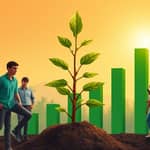
The journey of economic prosperity has long captured the imaginations of nations, policymakers, and citizens alike. In an era where resources are finite and competition is fierce, understanding the engines of growth is more critical than ever.
The Solow Growth Model offers a powerful lens through which we can decipher the mechanics of development, envision a path forward, and unlock practical strategies to foster lasting progress.
At its core, the Solow Model reveals how an economy’s output emerges from the interplay of capital, labor, and technology. By dissecting this relationship, we gain clarity on the forces propelling nations toward prosperity or holding them back.
Robert Solow’s pioneering work demonstrated that while capital accumulation is vital, it yields diminishing marginal returns to capital, meaning each new unit of investment contributes less output than the last. This insight transformed how economists and leaders approach development strategies.
Using a simple Cobb-Douglas production function, the model captures capital per effective worker converges to a steady state where growth stabilizes. In this equilibrium, the only driver of sustained expansion is the advance of technology, exogenous to the system yet indispensable in practice.
The notion of a steady state lies at the heart of the Solow framework. It represents a balance point where new investment precisely offsets the dilution of capital caused by population growth, depreciation, and technological progress.
Mathematically, the steady-state level of capital per effective worker is defined as k* = [s/(n + g + δ)]1/(1−α). Here, each parameter tells a story:
Above the steady state, economies experience capital dilution, leading output per worker to drift downward. Below it, rapid investment yields catch-up growth, showcasing the principle of conditional convergence.
The Solow Model’s practical power emerges when applied to real-world challenges. It explains why emerging economies often grow faster than developed counterparts: they start with lower capital per worker and benefit from one-off level boosts in output through rapid investment.
Yet, the model also cautions that without continuous innovation, even fast-growing nations will eventually slow. This highlights a profound policy insight: while increasing the savings rate can yield a higher output level, only sustained improvements in technology and efficiency can drive perpetual growth.
Policymakers can harness these lessons by targeting the golden rule savings rate—the optimal investment share that maximizes consumption per worker in the long run. Achieving this balance elevates living standards and ensures resources are not over-committed to capital at the expense of current well-being.
Turning theory into practice requires a multifaceted approach. Countries can adopt a series of strategic actions to align with Solow’s insights and pave the way for resilient, inclusive progress.
Each action reinforces the others, creating an ecosystem where capital and innovation flourish symbiotically. By investing in people and ideas, nations move beyond mere capital accumulation toward genuine, lasting advancement.
Although the Solow framework provides clarity, it also has its constraints. Technology growth is taken as given, human capital blends into the labor term, and the model assumes a closed economy devoid of trade or government intervention.
Recognizing these limitations fuels progress. Scholars have built upon Solow’s foundation to develop endogenous growth theories, integrating knowledge creation, human capital, and market structures into the narrative. By embracing these extensions, policymakers can craft more nuanced strategies to address modern challenges.
At its essence, the Solow Growth Model reminds us that progress is neither accidental nor guaranteed. It emerges from deliberate choices: how much we save, where we invest, and how we ignite innovation.
Every individual, community, and nation can take away a profound lesson: sustainable growth requires both patient capital accumulation and relentless pursuit of new ideas. By understanding the mechanics of steady states and transitional dynamics, we gain confidence that no economy is destined to stagnate.
Whether reconstructing after a shock or seeking to catch up with global leaders, countries wield the tools to chart their own destiny. In the words of Robert Solow himself, “Growth is a process of ever-widening circles”—and with the right policies, those circles can keep widening, reaching new horizons of prosperity and well-being.
References