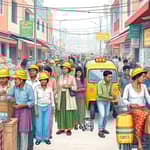
Beneath the surface of official economic data lies a vast, hidden world that shapes lives and nations in profound ways.
This shadow economy, often invisible to regulators, operates without official government regulation and permeates every corner of the globe.
From street vendors to unreported transactions, it generates trillions in revenue annually, impacting everything from tax revenues to social trust.
Understanding this phenomenon is not just an academic exercise; it is essential for fostering fairer societies and more resilient economies.
By exploring its scale, causes, and effects, we can uncover pathways to address its challenges and harness its potential for positive change.
At its core, the shadow economy encompasses all economic activities deliberately concealed from authorities to avoid regulation or taxation.
It includes both illegal ventures and everyday informal exchanges that fall outside formal systems.
This duality makes it a complex issue with far-reaching implications for governance and development.
Common activities in the shadow economy span a wide spectrum.
These elements collectively form a parallel economic structure that coexists with, and sometimes competes against, the formal sector.
Recent estimates suggest the shadow economy accounts for approximately 11.3% to 11.8% of global GDP, indicating its massive scale.
This represents a decline from previous decades, but it remains a significant force in many regions.
The variation across countries highlights how economic development and governance influence its prevalence.
Country-specific examples further illustrate this diversity.
This global footprint underscores the need for tailored approaches to address regional disparities.
The drivers of the shadow economy are multifaceted, often rooted in economic hardship and regulatory burdens.
In low-income nations, high poverty and limited formal opportunities push people into informal sectors.
Bureaucratic red tape and complex regulations can make compliance costly, encouraging evasion.
Key factors include:
For instance, welfare beneficiaries may face implicit tax rates of 116%, making shadow work more attractive.
This creates a cycle where individuals seek alternatives to survive and thrive outside official channels.
The shadow economy poses serious challenges, from fiscal losses to eroded trust in institutions.
Unreported income leads to lower tax revenues, impairing public services like healthcare and education.
This revenue gap can stifle infrastructure development and economic growth in affected regions.
Productivity suffers as informal activities often lack access to financing and technology.
Distorted economic indicators make it harder for policymakers to assess and plan for national needs.
Socially, a widespread shadow economy undermines confidence in governance and fairness.
It facilitates criminal activities such as money laundering and terrorism funding, posing security risks.
Broader development is hindered, with associations to higher poverty and slower progress on global goals.
These impacts highlight the urgency of addressing this issue through informed strategies.
Quantifying the shadow economy is challenging but possible through various methodologies.
Indirect approaches use macroeconomic indicators to estimate hidden activity.
The MIMIC (Multiple Indicator-Multiple Cause) method offers a more robust framework for cross-country comparisons.
Data sources like the World Bank and IMF provide valuable insights, though estimates can vary.
Accurate measurement is crucial for developing effective policies and understanding true economic health.
Direct enforcement efforts, such as increasing police forces, often yield minimal reductions in shadow activity.
For example, a 1 percentage point increase in spending on task forces leads to only a 0.05 percentage point reduction on average.
More effective approaches focus on addressing root causes and incentivizing formalization.
In the long run, integrating shadow economies can have positive effects, as seen in some regions.
Practical steps include supporting small businesses and improving governance transparency.
By fostering inclusive growth, societies can reduce reliance on informal markets and build more resilient economies.
This journey requires collaboration between governments, businesses, and communities to create lasting change.
The shadow economy is not an insurmountable problem but a call to action for better economic systems.
By acknowledging its existence and understanding its dynamics, we can work towards solutions that benefit all.
Inspiring stories from countries that have reduced informality show that progress is possible with dedication and innovation.
Let this knowledge empower you to advocate for policies that promote fairness and opportunity in your own community.
Together, we can shine a light on the shadows and build economies that are both prosperous and just for generations to come.
References