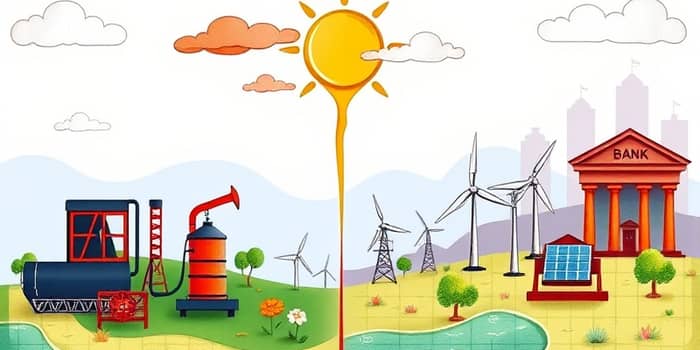
In the face of escalating climate crises, banks wield unprecedented power to steer the world toward a sustainable future. Their financial decisions can either accelerate or hinder the shift from fossil fuels to clean energy.
Current data reveals a troubling disparity: between 2021 and 2024, the 65 largest banks allocated $3,285 billion to fossil fuels, overshadowing the $1,368 billion directed to renewables.
This financing ratio of 0.42:1 underscores a critical gap that must be bridged to meet international targets and ensure environmental justice.
Current State of Energy Transition Financing
Bank financing patterns paint a concerning picture for the energy transition. Recent statistics highlight slow progress and persistent imbalances.
Key insights from 2021 to 2024 include:
- Banks provided $3,285 billion for fossil fuels compared to $1,368 billion for sustainable power like solar and wind.
- The Energy Supply Banking Ratio in 2024 was 0.89:1, meaning only 89 cents went to low-carbon energy per dollar to oil, gas, or coal.
- Global renewable investment hit a record $386 billion in H1 2025, yet utility-scale solar and onshore wind finance fell by 13% year-over-year.
- Banks reduced fossil fuel financing by approximately 25% in early 2025, but this is insufficient for rapid change.
These figures suggest that while some momentum exists, it falls short of what is needed. The International Energy Agency (IEA) projects that fossil fuel investments must drop by 60% by 2030.
Regional Disparities in Financing
Financing ratios vary widely across regions, reflecting divergent policies and bank priorities. This table summarizes key regional performances.
These disparities highlight urgent needs for targeted interventions, especially in regions like the US where policy reversals have stifled progress.
The Gap Between Current Efforts and Future Needs
To align with climate goals, significant shifts in bank financing are essential. The IEA and other experts outline clear requirements.
- Fossil fuel investments must drop by 60% by 2030, while renewable capacity needs to triple to 11,000 GW.
- Electricity's share of final energy should rise from 20% to 27% by 2030 and over 60% by 2050.
- Banks are urged to set sectoral targets of 6:1 for renewables to fossil fuels by 2030, or even 10
Geographic inequities exacerbate this gap. 93% of sustainable finance flows to OECD countries and China, neglecting the Global South where capital costs are seven times higher.
Challenges and Criticisms in Bank Practices
Banks face numerous obstacles that hinder effective financing for the energy transition. Common criticisms include inertia and lack of transparency.
- Many banks exhibit inertia in energy strategies, particularly in North America and Japan, keeping them off-track.
- Calculation flaws, such as excluding LNG terminals or including biomass as "low-carbon," distort true progress and accountability.
- Transparency issues arise when banks publish ratios that mask their fossil fuel bias, as seen with some major institutions.
- As UN Secretary-General Antonio Guterres noted, the transition is "not fast enough or fair enough," calling for urgent action.
Experts like Rémi Hermant emphasize that banks must "walk the talk" by stepping away from fossil fuels and boosting renewable investments.
Looking Ahead: Trends and Predictions for 2026 and Beyond
The future of energy financing is shaped by evolving trends and opportunities. Key projections offer both hope and caution.
- Renewables growth will be driven by storage solutions and increasing demand from sectors like AI and data centers.
- China is expected to dominate, holding a 46% global share in solar and storage capacity by 2026.
- Private financial institutions are set to play a larger role, supporting stability but facing tail risks.
- Positive trends include record investments in offshore wind and small-scale solar, despite economic headwinds.
For instance, global energy investment in 2025 is likely to reach $3.3 trillion, with $2.2 trillion directed to clean energy, signaling potential for reallocation.
A Path Forward: Practical Steps for Banks and Policymakers
To accelerate the energy transition, concrete and actionable steps are necessary for all stakeholders. Here are key recommendations.
- Banks should end financing for fossil fuel expansion and set clear, ambitious targets for renewable investments by 2030.
- Policymakers need to create stable environments through subsidies and derisking mechanisms, especially for emerging markets.
- Increasing transparency in reporting and avoiding flawed metrics will build trust and enhance accountability in financial flows.
- Prioritizing the power sector and supporting innovations in grid infrastructure and battery storage can unlock new economic opportunities.
- Collaboration between banks, governments, and NGOs is crucial to address geographic biases and ensure a fair transition for all regions.
By adopting these measures, banks can not only mitigate climate risks but also capitalize on the economic benefits of the clean energy revolution, fostering a sustainable future for generations to come.