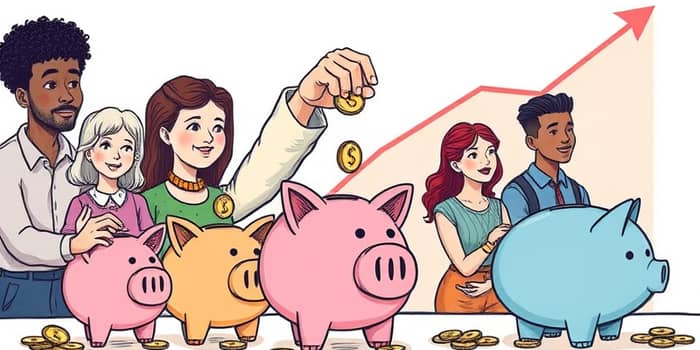
Saving money is often celebrated as a hallmark of financial responsibility, promising security and peace of mind. Yet there exists an unexpected twist in the world of economics: when everyone hoards too much, the very act meant to build prosperity can undermine it. This phenomenon, known as the paradox of thrift, reveals that under certain conditions, collective saving can backfire, shrinking incomes, investment, and overall economic health.
In this article, we will explore the origins of the paradox, the theoretical models that explain its mechanics, real-world examples where excessive saving deepened downturns, the main criticisms of the idea, and policy measures to strike the right balance between prudence and prosperity.
The basic intuition behind saving too much harming the economy dates back centuries. Early thinkers observed that if everyone held onto money, trade would slow and markets would stall. In 1714’s The Fable of the Bees, Bernard Mandeville floated a similar idea: private vices turning into public benefits and vice versa.
But it was John Maynard Keynes who crystallized the concept in his 1936 masterpiece, The General Theory of Employment, Interest, and Money. He warned, “Every such attempt to save more by reducing consumption will so affect incomes that the attempt necessarily defeats itself.” In Keynes’s view, when households cut spending en masse, they trigger a drop in aggregate demand, leading to lower output and employment. Ultimately, total savings may fall rather than rise.
At the heart of the paradox lies the circular flow of income and spending. In a simple closed economy, every dollar not spent on consumption becomes a leakage from this flow. If businesses cannot find buyers for their goods, they cut production, lay off workers, and incomes fall. Lower incomes translate into even less spending, creating a downward spiral of economic activity.
Key models illustrate this dynamic. In the Withdrawals–Injections (W–J) framework, an upward shift of the savings curve from S to S1 leaves the economy at a disequilibrium point where savings exceed investment at income level Y. As a result, national income falls to Y1, and aggregate savings revert to their original level, matching investment. The economy has saved no more in total, but output and employment suffer.
Wolfgang Stützel’s balances mechanics also highlight how individual surplus efforts translate into collective shortfalls: one household’s expense cuts create a revenue surplus for that household, yet when all households cut expenses, total revenues shrink.
History offers stark lessons on the paradox of thrift. During the Great Depression, widespread saving amid economic uncertainty exacerbated the downturn. Decades later, in the Great Recession of 2007–08, American households raised their saving rate from 2.9% pre-crisis to around 5% by 2011, slowing the recovery despite record-low interest rates. More recently, the COVID-19 pandemic spurred another surge in precautionary savings, contributing to sharp declines in consumption, GDP, and employment worldwide.
While the paradox of thrift offers powerful insights for demand-driven downturns, it has drawn various critiques. Critics from the classical and neoclassical schools argue that savings do not vanish but are intermediated through banks, fueling investment and innovation. They contend that higher savings lower interest rates, encouraging capital accumulation and long-term growth.
Some also note that the paradox focuses on short-term cyclical effects, overlooking the supply-side benefits of robust savings in financing future growth and technological progress. Furthermore, distinguishing between cash hoarding and deposits is key: only the former tightens spending immediately.
Recognizing the paradox of thrift carries crucial lessons for policymakers and individuals alike. In recessionary contexts, countercyclical measures can offset the drag of excessive saving. At the same time, encouraging wise personal finance habits remains important.
The paradox of thrift challenges us to rethink the simple mantra that more savings are always better. When the entire community tightens its belt simultaneously, the economy can buckle under the weight of its own frugality. This insight does not demonize saving—but it underscores the importance of timing and context.
In healthy, growing economies, robust savings finance new ventures, technological breakthroughs, and rising living standards. Yet in downturns, excessive collective saving can deepen contractions, robbing households of income, jobs, and future wealth. Understanding this delicate balance helps individuals, businesses, and governments navigate crises more wisely.
As you plan your personal finances, remember that your decisions ripple through the broader economy. By pairing prudent saving with timely spending—whether supporting local businesses or investing in community projects—you contribute to a virtuous cycle of growth. In doing so, you honor both your long-term security and the shared prosperity that emerges when we spend, invest, and grow together.
References