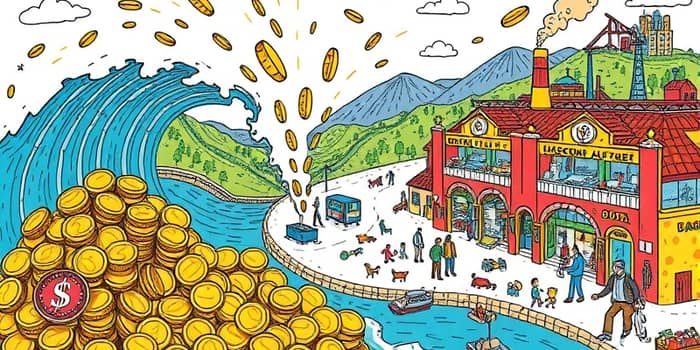
Imagine a single dollar set into motion and returning as five dollars worth of economic activity. This is the power of the initial spending injection known as the multiplier effect, a concept that reveals how one act of spending can spark a chain reaction of consumption throughout an economy. By understanding how incomes and expenditures feed one another, policymakers, businesses, and individuals can harness this phenomenon to stimulate growth and narrow output gaps.
At its heart, the multiplier effect describes how an extra dollar spent by a government, firm, or consumer generates additional rounds of spending that cumulatively exceed the original amount. As fresh funds enter the economy, incomes rise, fueling further expenditures and setting off a virtuous cycle. Let’s explore how this unfolds, the mathematics behind it, real-world examples, limitations, and policy uses.
When a government allocates $1 million to build a factory, that money appears as wages for construction workers and revenue for suppliers. These workers and suppliers, now flush with new income, spend a portion on groceries, rent, or leisure. Each of these outlays becomes income for others, reinforcing multiple rounds of new spending. In turn, the cycle persists until leakages absorb the remaining funds.
This circular flow of money illustrates the multiplier: every round of spending creates income, which then transforms into new consumption. The faster money circulates and the higher people’s willingness to spend, the stronger the multiplier’s impact.
At its simplest, the multiplier (m) equals 1 divided by one minus the marginal propensity to consume (MPC). In formula form:
m = 1 / (1 – MPC)
Here, MPC measures the share of additional income that households spend rather than save. A higher MPC translates into a larger multiplier. Equivalently, since marginal propensity to save (MPS) is 1 minus MPC, we can write:
m = 1 / MPS
In more complex settings with tax collections and imports, the multiplier becomes:
m = 1 / (MPS + MRT + MPM)
where MRT is the marginal rate of taxation and MPM the marginal propensity to import. These leakages reduce the funds available for domestic spending, tempering the multiplier’s size.
Consider Frank, who receives a $500 stimulus check. He spends $400 at a local store. The store owner saves $200 and spends $100 on cleaning services. The cleaner then uses that $100 to buy groceries. In this simplified chain, a $500 injection yields $500 + $400 + $100 = $1,000 in total spending, demonstrating how each round amplifies activity.
Similarly, if a government spends $1 billion on infrastructure with an MPS of 0.2, the multiplier equals 1/0.2 = 5. The resulting boost to GDP can reach $5 billion, five times the initial outlay, provided resources are idle and taxation is not prohibitive.
A high MPC and quick circulation yield a more pronounced multiplier. When households save heavily or taxes and imports siphon off a large share, the effect diminishes.
The multiplier reaches its peak during economic downturns or when resources sit idle. In recessions, unemployed labor and unused capacity combine with fiscal stimulus to deliver robust returns on public spending. Governments facing wide output gaps deploy stimulus packages, confident that each dollar injected unleashes several dollars of production.
Not all spending yields multipliers above one. Projects like sports stadiums sometimes exhibit values below unity, where government outlays merely replace private investment. Interest rates may rise as borrowing increases, discouraging consumption and business expansion. When initial spending pushes up prices or rates, it can crowd out private sector activity, offsetting much of the intended gain.
Fiscal authorities routinely harness the multiplier effect. During the 2020 global recession, emergency stimulus checks, enhanced unemployment benefits, and infrastructure spending injected trillions of dollars into economies. Central banks complemented these measures through bond purchases and interest rate cuts, magnifying the impact. Studies show that well-timed stimulus in deep recessions can achieve multipliers above 1.5, enough to close significant output gaps.
Even a balanced budget approach—where new spending is matched by tax hikes—can expand GDP when unemployment is high. Reduced financial hoarding and revived business confidence encourage private actors to spend, generating an upward spiral of economic revival.
Understanding the multiplier effect illuminates why targeted spending can rejuvenate entire economies. From a single stimulus check to billion-dollar infrastructure projects, the principle remains: an extra dollar spent today can yield several dollars of tomorrow’s income. For policymakers, investors, and citizens, embracing this knowledge enables smarter decisions, fostering growth, employment, and shared prosperity.
References