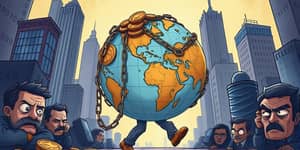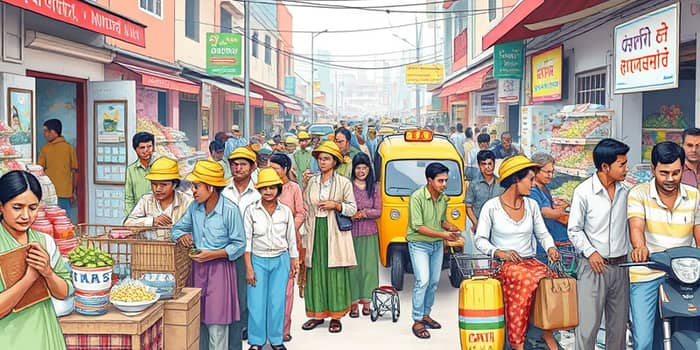
In the shadows of formal markets, a dynamic force thrives, shaping lives and economies worldwide.
The informal economy represents a vast network of unregulated activities that escape government oversight yet sustain billions.
Understanding this sector is crucial for building resilient and equitable societies in an interconnected world.
It encompasses jobs and enterprises not taxed or monitored, from street vendors to home-based workers.
These activities provide essential goods and services, often filling gaps left by formal systems.
The informal economy includes economic activities neither taxed nor monitored by government, as defined by organizations like WIEGO.
It excludes illegal endeavors but covers unregulated jobs, small enterprises, and self-employment without formal contracts.
This sector offers diversified opportunities for millions, yet lacks social protection and legal benefits.
Key characteristics include flexibility, low entry barriers, and often, a survival-driven nature.
Globally, the informal economy is immense, involving around 2 billion people.
This represents approximately 60% of the world's workers, highlighting its pervasive role.
In many regions, it accounts for a significant share of GDP and employment.
Informal employment is a job characteristic, not inherently tied to individual workers.
In low and middle-income countries, it serves as a primary source of income for many families.
In advanced economies, it can mitigate economic downturns by absorbing labor force entrants.
Multiple factors drive informality, with no single cause dominating.
A blend of structural and individual elements shapes its persistence and growth.
Key drivers include:
Voluntary participation also plays a role, such as tax evasion or seeking work-family balance.
Events like childbirth can significantly increase women's informality, as seen in Mexico with a 38% rise.
Social norms and kinship networks further sustain informal activities where formal systems fail.
The informal economy has dual effects, offering both opportunities and challenges.
On the positive side, it absorbs surplus labor and provides entrepreneurial avenues.
However, negative impacts are profound and far-reaching.
Social and labor consequences include increased vulnerability for workers.
Various theories explain the informal economy's existence and dynamics.
Understanding these helps in crafting effective policies and interventions.
Segments within the informal economy include self-employed individuals, informal wage workers, and home-based employers.
Gender splits are notable, with women disproportionately represented in vulnerable roles.
Addressing the informal economy requires nuanced approaches that balance integration with protection.
Recent trends show declines in some regions, but urban expansion in Asia keeps it relevant.
Key policy levers include:
Diagnostics should distinguish between voluntary and involuntary informality to target interventions effectively.
Growth in the 21st century is driven by labor absorption limits, weak institutions, and low-cost demand.
By fostering inclusive policies, societies can harness the informal economy's potential while mitigating its risks.
This journey towards formalization is not about eradication but about creating opportunities for all.
It calls for collaborative efforts from governments, businesses, and communities to build a fairer economic landscape.
References