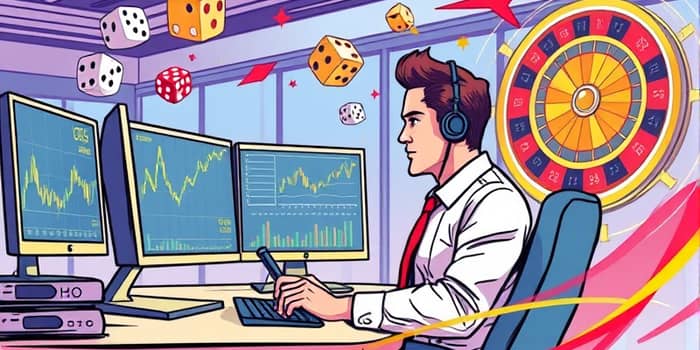
In the high-stakes world of financial trading, a subtle yet powerful bias often dictates decisions, leading traders down a path of false confidence. The illusion of control in trading convinces individuals that their skills can steer unpredictable markets, when in reality, chance plays a dominant role.
This cognitive bias, first identified by psychologist Ellen Langer, stems from our brain's innate desire to avoid uncertainty. Traders find themselves overestimating their influence, believing that every chart movement requires their intervention.
The consequences are profound, affecting not just portfolios but long-term mental well-being. Understanding this bias is the first step toward mastering the markets with clarity and restraint.
The illusion of control is the tendency for people to overestimate their ability to control events. In trading, this manifests as traders believing their knowledge or strategy can sway market trends.
Markets are influenced by countless unpredictable factors, making true control an illusion. This bias was named by Ellen Langer and is linked to other positive illusions like illusory superiority.
Overestimate their ability to control outcomes often leads to overconfidence. It reinforces the false belief that personal effort can dominate random market fluctuations.
Our brains are wired to avoid uncertainty. When faced with unpredictability, we instinctively try to intervene and fix the situation.
Trading amplifies this instinct because every price movement feels like a call to action. This leads to overconfidence and emotional decision-making.
Several factors strengthen this bias in traders, making it a persistent challenge in financial environments.
Emotional decision-making leads to overconfidence, blurring with rational thinking. Recognizing this distinction is crucial for effective trading.
Traders under the illusion of control exhibit common patterns that harm their performance. These behaviors are often driven by a false sense of mastery.
The activity trap is a key manifestation. Traders confuse motion with mastery, thinking that being active means being in control.
Clicking buttons or making trades feels like progress, but it often worsens outcomes. This is a coping mechanism for psychological discomfort.
Emotional triggers include price movements that scream "Do something," or approaching key levels that urge "Don't miss it."
Ignoring market warnings due to infallibility can lead to catastrophic losses. Traders must learn to listen to external signals.
Our ancestors survived by controlling their environment, making this bias a deep-seated instinct. In trading, this manifests as a need to intervene in unpredictable markets.
The metaphor of pressing an elevator button repeatedly mirrors overtrading. It feels like action, but it doesn't change the outcome.
This evolutionary background explains why the brain's wiring avoids uncertainty. It is a survival mechanism misapplied in modern finance.
Research shows that the illusion of control has significant negative effects on trading performance. Traders prone to this bias score lower on critical skills.
They earn less overall and contribute less to profits. The financial and psychological damage is substantial and often compounding.
A study by Barber and Odean found that frequent traders earn 6.5 percentage points lower annual returns. This highlights the cost of illusion-driven behavior.
Compounding erosion of capital is a silent threat. It disguises itself as effort, making it hard to detect until it's too late.
There is a key contradiction: people overestimate control in chance situations but underestimate it when they actually have control. This paradox challenges common theories.
The performance paradox reveals that success in trading comes from restraint, not intensity. Experienced traders know that discipline, not action, generates profit.
Beginners often think the market rewards constant participation. However, professionals understand that precision and patience are far more valuable.
Restraint and discipline generate profit, not mere activity. This shift in mindset is essential for long-term success.
Overcoming the illusion of control is not about eliminating it entirely, but managing its influence. Several techniques can help traders stay grounded.
Behavioral techniques include mindfulness and cognitive restructuring. These help traders stay present and challenge irrational thoughts.
Systematic approaches provide a framework for consistent decision-making. A disciplined trading plan is essential for avoiding impulsive actions.
The acceptance framework involves recognizing limitations and focusing on controllable factors. By doing so, traders can tilt the odds in their favor.
Answering the core question in a journal: "Why did I enter this trade?" often exposes emotional triggers. This honesty weakens the illusion's power.
Focus on controllable factors like discipline to improve outcomes. Letting go of the need to master chance is liberating.
The illusion of control is a deeply ingrained bias that can derail even the most skilled traders. By understanding its origins and manifestations, traders can develop strategies to counter it.
Focus on what you can control: your discipline, risk management, and emotional responses. Let go of the need to master chance, and instead, master yourself.
This journey from illusion to insight is what separates successful traders from those trapped in cycles of loss. Embrace the uncertainty, and trade with clarity and confidence.
Master yourself to navigate markets effectively. The path to trading success lies in self-awareness and strategic restraint.
References