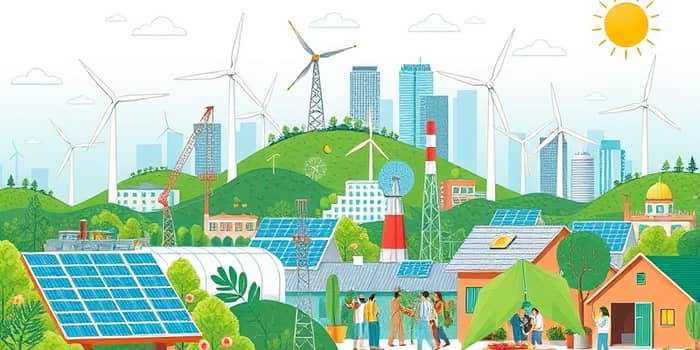
The global shift towards sustainability is no longer just an environmental imperative; it's become a dynamic economic revolution. As nations, corporations, and investors rally around renewable energy, resource efficiency, and innovative technologies, the green economy emerges as a powerful driver of growth, resilience, and long-term prosperity. Over the past decade, groundbreaking advances have lowered costs, opened new markets, and fostered a spirit of collaboration between the public and private sectors. This transformation, underpinned by significant capital flows and evolving policies, offers a roadmap for creating resilient industries, inclusive societies, and thriving communities that can adapt to changing climate realities and socioeconomic demands.
Over the past decade, the green economy has transformed from a niche sector into a cornerstone of global markets. As of 2025, the global green economy has surpassed $5 trillion, making it the second-fastest growing sector worldwide, outpaced only by technology.
This momentum reflects a broad realignment of capital towards clean energy, climate resilience, and circular solutions, setting the stage for continued expansion through the end of the decade. Institutional investors, pension funds, and sovereign wealth funds are progressively allocating greater shares of their portfolios to green assets, driven by both ethical commitments and robust financial performance. At the same time, emerging economies are catching up, harnessing green technologies to leapfrog traditional industrial models and chart a low-carbon path tailored to local needs.
A diverse array of sectors attracts the bulk of green investments. Clean energy technologies such as solar, wind, and next-generation battery manufacturing remain at the forefront, backed by policy incentives and private capital.
These areas represent the frontlines of climate action and economic transformation. Clean energy projects benefit from technological advancements in photovoltaic efficiency and wind turbine design, while sustainable transport is buoyed by falling battery prices and expanding charging infrastructure. Circular economy initiatives reclaim materials, extend product lifecycles, and minimize environmental footprints, offering both environmental benefits and cost savings. In urban centers, retrofitting existing buildings with advanced insulation and smart energy management systems can drastically reduce emissions while enhancing occupant comfort and lowering utility bills.
Adaptation solutions now account for over 20% of climate-related investments, reaching $1.1 trillion annually. Yet, a glaring gap persists: the estimated $1 trillion annual funding shortfall for biodiversity preservation contrasts with a potential $10.1 trillion in value from nature-positive practices.
Leading the eastern surge, China invested an astonishing $659 billion in clean energy in 2024, more than 50% above its closest rival. The nation dominates global capacity additions, responsible for over 60% of new renewable installations through 2030.
Bolstered by scale, coordination, and industrial policy, China’s rapid advancements across solar panels, wind turbines, battery manufacturing, and green technology patents have repositioned the global innovation centre in the East.
China’s state-led approach has combined strategic planning with massive infrastructure build-out, creating a virtuous cycle of innovation, production, and deployment. Alongside public investment, private enterprises and research institutions collaborate to refine manufacturing processes, develop cutting-edge battery chemistries, and scale new energy technologies. This synergy has generated economies of scale that drive down costs globally, making renewable energy more accessible and competitive in markets across the world.
For businesses, green strategies have translated into tangible financial benefits. Companies with at least 50% of revenues derived from sustainable products enjoy valuation premiums of 12-15% compared to their peers, while also securing more favorable financing terms.
These results underscore the growing alignment between sustainability and shareholder value, illustrating how environmental commitments can drive competitive advantage. Beyond pure financial metrics, companies embedded with strong environmental practices also report enhanced brand reputation, greater supply chain resilience, and improved employee engagement. Such firms often attract top talent motivated by purpose-driven work, further amplifying innovation and long-term performance.
The green transition is propelled by three core drivers: climate mitigation policies, technological innovation, and shifting consumer and corporate preferences. Governments deploy a mix of carbon pricing, green subsidies, and stringent standards to accelerate decarbonization.
These policy levers not only incentivize green investments but also provide clear signals that guide corporate strategy and consumer decisions. Carbon pricing, whether through taxes or cap-and-trade schemes, internalizes environmental costs and accelerates the shift to low-carbon alternatives. Green subsidies and targeted R&D funding jumpstart emerging technologies, while stringent standards for emissions, efficiency, and waste management create level playing fields that reward sustainable practices. When aligned, these policies can create a stable environment where businesses prosper by decarbonizing their operations and supply chains. According to recent surveys, nearly 90% of finance ministries now recognize the shift to a resilient, low-carbon economy as a central economic priority, integrating sustainability into fiscal frameworks.
Transitioning to a green economy requires far-reaching structural transformation and investments across power generation, transportation, construction, manufacturing, and agriculture. The magnitude of this shift holds profound implications for citizens, businesses, and public budgets.
Moreover, the transition is fostering the emergence of new financial instruments—from green bonds and sustainability-linked loans to dedicated climate funds—which are broadening the investor base and reducing the cost of capital for sustainable projects. As finance ministers increasingly integrate climate risks into fiscal planning and debt management strategies, public budgets are being reoriented to support low-carbon infrastructure, innovation, and social safety nets for affected workers and regions.
Despite macroeconomic uncertainties and regulatory bottlenecks, the green sector’s resilience shines through. As we approach 2026, the proposition is clear: the economics of cleantech has overtaken the politics, offering cost-effective paths to decarbonization and a compelling case for investors. Sectors once perceived as niche, such as green hydrogen, carbon capture, and advanced recycling, are poised to enter mainstream portfolios, expanding the scope and scale of the green economy.
The green transition is not only an environmental imperative but also a catalyst for job creation and socioeconomic development. Millions of new roles could emerge in renewable energy, sustainable agriculture, circular manufacturing, and ecosystem restoration.
Creating millions of green jobs will require targeted training programs, educational initiatives, and partnerships between industry, academia, and government. Vocational training centers can equip workers with skills in renewable energy installation, sustainable agriculture, and eco-friendly construction, while investment in research and development fosters high-skilled positions in engineering, data analytics, and environmental science.
A truly just transition must create societal and economic systems that distribute benefits equitably, ensuring that communities historically reliant on carbon-intensive industries are empowered through retraining, investment, and inclusive policymaking. Equity considerations are central to the transition. A just approach must address regional disparities, support communities facing economic disruption, and ensure that vulnerable groups benefit from new opportunities. Social dialogues, community-driven planning, and transparent governance frameworks can help mitigate the social risks of structural change and build inclusive pathways forward.
Now is the moment for investors, policymakers, and civil society to collaborate in shaping an economy that prioritizes both prosperity and planetary health. By channeling capital into sustainable solutions, we can accelerate a future where green growth, social equity, and environmental stewardship reinforce one another, forging a path to a resilient and thriving global economy.
References