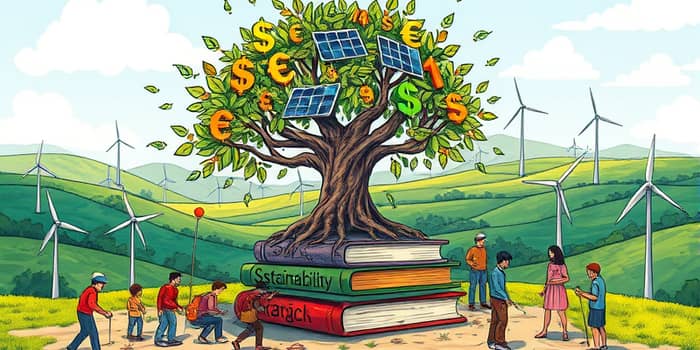
In today's world, a powerful shift is underway where ecological responsibility yields tangible rewards.
This concept, known as the Green Dividend, represents the economic and social advantages gained from prioritizing sustainability.
It fundamentally challenges old paradigms by showing that sustainability multiplies growth rather than hindering it.
By investing in our planet, we unlock benefits that ripple through communities and economies.
The Green Dividend is not just an idea; it is a practical framework for a better future.
The Green Dividend operates at various levels, from individual actions to systemic changes.
At the individual and community level, immediate benefits are clear and impactful.
These actions create a foundation for broader societal gains.
On a systemic scale, green infrastructure unlocks even greater dividends.
Policy-driven returns further amplify these effects.
This multi-level approach ensures that benefits are widespread and sustainable.
Several economic theories explain the mechanisms of the Green Dividend.
The double dividend hypothesis is a key framework in environmental economics.
This can lead to increased economic efficiency and job creation.
The Porter Hypothesis suggests that regulations spur innovation.
From a systems perspective, ecosystem services provide intrinsic value.
These theories highlight why sustainability is a smart economic strategy.
The Green Dividend manifests in diverse industries, from energy to agriculture.
Consider the following table of green investment areas and their returns:
In manufacturing, sustainability strengthens global competitiveness.
Capital markets are increasingly favoring sustainable enterprises.
Real estate examples, like alstria's Green Dividend proposal, show practical implementation.
India's aim for a $10 trillion economy relies heavily on the Green Dividend.
Sustainability acts as an economic multiplier, not a constraint.
Key elements driving this include:
The risk calculus is inverted: costs of inaction exceed investment.
This makes growth sustainability as crucial as growth speed for India's future.
Every green initiative contributes to long-term economic resilience.
Practical frameworks exist for communities to harness the Green Dividend effectively.
These models integrate economic development with environmental goals.
Business assessments now include metrics beyond profits.
Community bonds are strengthened through collaborative environmental projects.
The Green Dividend extends to social and ecological well-being, enriching lives.
It strengthens social capital and revitalizes community connections.
Investing in planetary boundaries yields long-term stability and reduced risk.
Ultimately, it builds worlds where human and ecological systems thrive together.
The intrinsic value of preserving natural heritage for future generations is priceless.
This expansion of progress metrics includes planetary and human well-being.
Contemporary focus areas are exploring new dimensions of the Green Dividend.
Behavioral economics informs policy design to maximize sustainable choices.
Research shows a positive link between green practices and financial performance.
These insights pave the way for innovative solutions and broader adoption.
The Green Dividend offers a compelling path to a prosperous and sustainable future.
By prioritizing ecological responsibility, we unlock rewards that benefit everyone.
It is time to see sustainability as the key to unlocking true, lasting growth.
Let us seize this opportunity to create a world where economy and ecology flourish together.
References