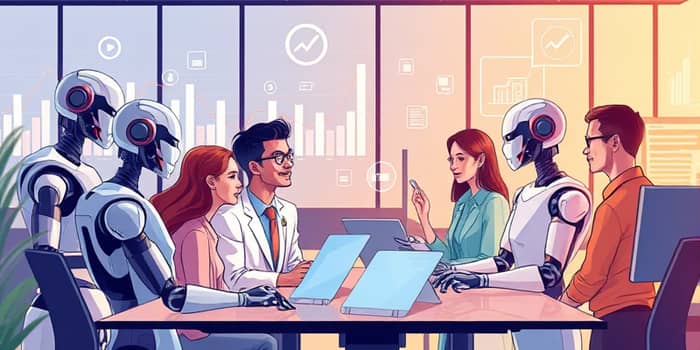
As we stand at the crossroads of technological progress, artificial intelligence is not a distant prophecy—it is reshaping our work lives with unprecedented speed and scale. From boardrooms to factory floors, AI-driven innovations are transforming how we think, decide, and execute tasks.
This article dives into the numbers, trends, and human stories behind the seismic shifts in today’s labor market. You will discover practical strategies to adapt, thrive, and shape your career in an era of rapid acceleration.
Recent reports reveal that nearly 40 percent of global jobs face meaningful changes from AI exposure. In the past year alone, tasks fully automatable rose from 1 percent to 10 percent, while those partially assistable jumped from 15 percent to 40 percent. “Our 10-year forecast is happening today,” warned leading consultants, noting that managerial and hyper-specialized roles are in the crosshairs.
Jobs once seen as safe—like healthcare diagnostics, educational assessments, and legal research—are now subject to algorithmic insights and automated reasoning. In manufacturing and operations, perception-driven robotics and agentic AI can schedule, budget, and even train junior staff, accelerating disruption beyond original expectations.
Certain sectors have already felt the brunt of this transformation. Healthcare, education, and legal services show the highest AI exposure scores, with nearly one in three roles seeing significant change. Physical and operational work is not far behind.
Conversely, creative arts, skilled trades, and some front-line service roles remain less exposed, though even those categories are evolving as multimodal AI learns to see, speak, and adapt.
The macro data paints a sobering picture. U.S. payroll gains for 2025 were revised from +584,000 to just +181,000. January 2025 jobs swung from +111,000 to –48,000 in updated figures. By August, another –70,000 revision deepened concerns about underlying growth.
Layoff numbers tell a similar story. In January 2026, approximately 110,000 Americans were laid off, with only 5,000 new positions planned—a startling 1:20 ratio. AI-attributed layoffs topped 55,000 in 2025, though many analysts warn of “AI-washing,” where workforce cuts are justified under the guise of automation promises.
These figures underline the urgency for both workers and organizations to rethink hiring, training, and retention strategies in an AI-infused economy.
Facing these trends, many companies are pivoting from pilot programs to full integration. A recent survey found that 20 percent of organizations plan to flatten hierarchies by 2026, eliminating over half of middle management layers. McKinsey cut its headcount by 25 percent, PwC trimmed 5,600 roles while training 315,000 employees in AI, and Deloitte committed $3 billion to generative AI over the next five years.
At the same time, AI investments are up: corporate spend on model providers climbed from zero to 2.85 percent of budgets. Yet online labor marketplace spending dropped from 0.66 percent to 0.14 percent, suggesting firms are choosing internal AI solutions over outsourced gig work.
These shifts reflect a broader trend: AI moving from experimentation to core operations. Companies are redesigning workflows around human-AI collaboration, embedding intelligent assistants directly into daily tasks.
For many employees, especially early-career professionals, the landscape is challenging. Entry-level hires in AI-exposed roles declined by 13–20 percent for workers aged 22–25. Temporary help employment is down by 577,000 since its March 2022 peak. Meanwhile, those with AI skills command a wage premium, even as overall employment in vulnerable occupations fell by 3.6 percent over five years.
Despite these headwinds, evidence suggests resilience. A Brookings analysis found that 71 percent of high-exposure U.S. workers demonstrate strong adaptive capacity. Those in the top quartile of AI-exposed roles are more likely to acquire new skills and pivot to emerging opportunities.
As we look toward 2035, forecasts estimate that up to 30–50 percent of job tasks could be economically automatable. This represents a labor shift valued at roughly $4.5 trillion. Yet such transformations also create new roles in AI governance, ethics, data management, and hybrid human-machine teams.
Organizations that embrace proactive adaptation will benefit from improved productivity and innovation. Workers who cultivate AI literacy and critical thinking skills stand to gain the most, securing higher wages and more meaningful work.
The story of automation need not be one of displacement alone. History shows that technological revolutions ultimately generate net employment growth. However, the current pace demands faster responses from employers, educators, and policymakers.
By investing in lifelong learning, fostering inclusive AI governance, and cultivating a culture of collaboration, we can navigate this era with confidence. The future of work is already unfolding—our collective choices will determine whether it becomes an era of opportunity or upheaval.
Embrace the change, equip yourself with new skills, and partner with AI as a catalyst for growth. In doing so, you will not only safeguard your career but also shape an equitable and prosperous work environment for future generations.
References