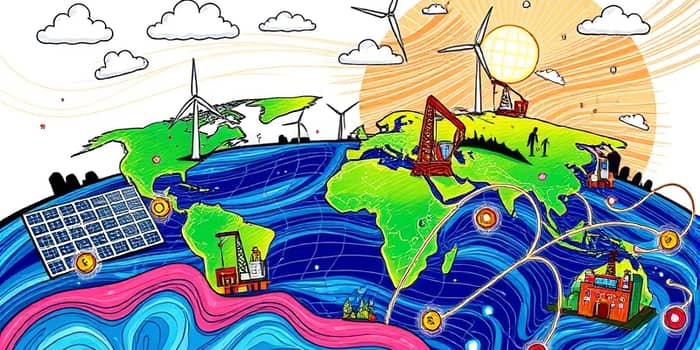
The world stands at a pivotal moment in energy history, where resources, prices, and policy intersect to shape our collective future.
Global energy investment in 2025 likely passed $3.3 trillion, with clean energy technologies capturing a significant share.
This transformation offers immense opportunities for innovation and sustainability, inspiring hope and actionable insights.
Understanding these dynamics is key to navigating the complex energy landscape effectively.
Global energy supply increased by 2% in 2024, driven by rises across all forms of energy.
For the first time since 2006, all major energy sources reached record consumption levels.
Fossil fuels continue to dominate, accounting for 86% of the global energy mix.
Regional demand patterns show significant variations, with Asia Pacific leading the growth.
Global electricity demand is projected to rise by 3.7% in 2026.
This follows a 3.3% increase in 2025, highlighting sustained growth in power needs.
Renewable energy is poised to become the world's top source of electricity by 2026.
Wind and solar output topped 4,000 terawatt hours in 2024 and will exceed 6,000 TWh by 2026.
However, global solar additions are expected to decline year over year for the first time.
China's annual renewable additions are forecast to fall from 300 GW in 2025 to 200 GW in 2026.
A major policy shift triggered a slowdown, creating intense price pressure across the supply chain.
Global renewable capacity is expected to rise by 4,600 GW by 2030.
Solar will account for roughly 80% of this increase, underscoring its critical role.
Since 2010, renewables and nuclear have avoided 110 gigatonnes of greenhouse gas emissions.
Power-sector emissions are set to decline by 2026 as coal-fired generation decreases.
This decline is driven by falls in China and the EU, marking a positive environmental trend.
Energy storage plays a vital role in supporting this transition to cleaner energy.
Battery energy storage system (BESS) investment jumped by 50% in 2025 on falling costs.
This makes storage more accessible and practical for grid stability and renewable integration.
Green hydrogen is emerging as a strategic energy source, particularly in China.
China has become the global leader in electrolytic hydrogen, with deployment set to grow exponentially.
Green hydrogen is central to China's plan to dominate clean energy supply chains.
It offers an outlet for excess electricity, converting it into molecules for export.
Sustainable aviation fuel (SAF) consumption more than doubled in 2025 to 2 million metric tons.
Growth in 2026 will be less pronounced due to policy shifts in the US and EU.
More than half of global SAF capacity will be concentrated in Asia by 2026.
Asian producers benefit from lower costs and abundant feedstock supplies.
They are targeting the European market, which faces a supply shortfall.
Brent crude oil is forecast to average $56-$59 per barrel in 2026.
This represents a 19% decline from 2025, driven by oversupply and strategic shifts.
Global oil production is expected to exceed demand in 2026, causing inventories to rise.
The OPEC+ strategy to dampen non-OPEC supply by driving prices down is working.
Intensifying geopolitical tension may limit downside price movement, adding complexity to forecasts.
Henry Hub natural gas spot prices are forecast to average just under $3.50/MMBtu in 2026.
Global LNG prices are entering an anticipated slump, with European prices already declining.
A massive new wave of LNG supply from the US and Qatar will ramp up through 2026.
This will further pressure prices, shaping global energy trade and policy decisions.
To thrive in this evolving landscape, stakeholders must embrace innovation and adaptability.
Investors should focus on diversification, balancing traditional and emerging energy sources.
Policy makers play a crucial role in setting incentives and regulations that drive progress.
Consumers can benefit from lower energy costs and increased access to clean alternatives.
By understanding price trends and resource availability, better decisions can be made for sustainability.
The transition to a cleaner energy future is not just possible but inevitable.
With strategic planning and collaboration, we can harness economic forces for environmental good.
This journey inspires hope and empowers action, creating a legacy of resilience and prosperity.
References