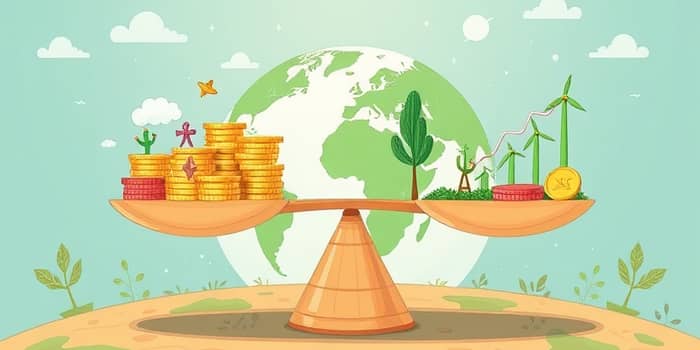
Climate change is no longer a distant environmental concern; it is a powerful economic force reshaping our world with deep-seated costs and transformative opportunities. The financial implications touch every corner of society, from household budgets to global markets, urging us to rethink our approach to growth and resilience.
Recent studies paint a stark picture, revealing that the slow erosion of income through interconnected supply chains is already underway. This economic shift is not just about future projections; it is a present reality with tangible impacts on our daily lives.
By understanding these dynamics, we can uncover pathways to mitigate losses and harness innovation. This article delves into the hard data, offering a comprehensive look at both the staggering costs and the hopeful opportunities ahead.
Already, climate change is imposing measurable financial burdens. In the United States, for instance, income has declined by approximately 12% due to routine temperature changes since the 1960s.
This loss stems from more frequent hot days and fewer cold days, disrupting productivity and trade networks. The ripple effects are profound, as weather shifts in one region can impact incomes far away through price adjustments.
Households are feeling the pinch directly. Costs can reach up to $1,000 per year for the average family, driven by factors like wildfire smoke health impacts and rising insurance premiums in coastal areas.
These current costs are just the beginning, highlighting the urgent need for adaptation strategies to cushion our economies.
Looking ahead, the financial outlook becomes even more daunting. By 2049, global damages could soar to $38 trillion annually, a sum exceeding twice the European Union's GDP.
This staggering figure represents a 19% loss in per capita income within just 26 years, underscoring the rapid escalation of climate risks. Each degree of warming translates to significant economic setbacks, with models suggesting a 1-4% annual GDP loss in the US by 2100 under high emissions scenarios.
These projections are not mere speculation; they are based on rigorous economic analyses that factor in mortality, labor shifts, and energy sector changes.
Extreme weather events are becoming more frequent and costly, with billion-dollar disasters now commonplace. In the US alone, total losses have surpassed $3.1 trillion from 426 events recorded to date.
Insured losses are on the rise, expected to hit $145 billion globally in 2025, a 6% increase from the previous year. Peak years could see losses reaching up to $300 billion from hurricanes and earthquakes alone.
Globally, historical losses from 1995 to 2024 total $4.5 trillion in inflation-adjusted direct economic damages, with over 832,000 lives lost.
These figures highlight the compounding nature of climate impacts, urging us to prepare for more frequent and severe events.
Addressing climate change requires substantial upfront investments, particularly in mitigation and adaptation efforts. For developing economies, these costs could reach $5.5 trillion per year from 2023 to 2030.
This represents up to 40% of GDP for some of the least developed countries, highlighting global inequalities as poorer nations bear a disproportionate burden. However, these expenses are often dwarfed by potential damages, with studies indicating that mitigation costs are six times lower than projected losses from climate change.
Investing now can save trillions in avoided damages, making it a smart economic strategy for long-term stability.
The economic effects of climate change are not evenly distributed, with significant disparities between regions and nations. While the US faces income erosion, developing economies often experience higher proportional costs.
Subnational analysis reveals that within countries, some areas are hit harder than others, affecting local economies and communities. Global models show that a 1°C rise in temperature could lead to a 12% loss in world GDP, emphasizing the need for coordinated international efforts.
This table underscores the varied financial burdens, calling for tailored policies that address local needs while fostering global cooperation.
Economists use advanced models to quantify climate impacts, incorporating factors like temperature persistence and trade linkages. These methods reveal that costs are often underestimated, as they exclude extreme events and rely on historical data.
By improving these models, we can better forecast risks and allocate resources effectively. Understanding these tools is crucial for turning data into actionable insights for policymakers and businesses.
Enhanced methodologies can help societies prepare more accurately, reducing uncertainties and guiding investment decisions.
Amidst the costs, there are bright spots for economic transformation. Investing in resilience can offset damages, with green technologies offering new avenues for growth. Policy shifts and business adaptations can harness trade linkages to build a more robust economy.
For example, annual climate-cost tracking, similar to GDP indicators, can help societies plan and adapt. By framing climate action as an investment in future stability, we can mobilize public and private support for sustainable initiatives.
These opportunities not only mitigate losses but also drive economic diversification, turning climate challenges into catalysts for progress.
The economics of climate change present a stark yet hopeful narrative. By acknowledging the costs and seizing the opportunities, we can steer toward a sustainable future where economy and environment thrive together.
Every dollar spent on mitigation saves multiples in avoided damages, making climate action a smart economic choice. Let this knowledge inspire us to act with urgency and creativity, building a resilient world for generations to come.
The journey ahead requires collective effort, but with informed strategies and a commitment to innovation, we can transform this global challenge into a story of economic renewal and shared prosperity.
References