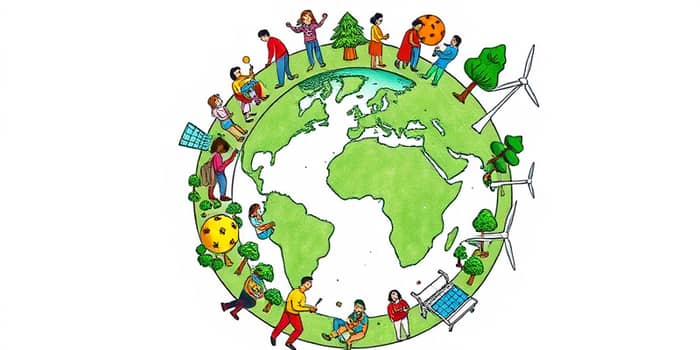
At a critical juncture in our planet’s history, the circular economy emerges as a beacon of hope, offering a path to sustainable growth and ecological harmony.
It challenges the ingrained patterns of extraction and disposal, inviting us to reinvent our relationship with resources and the environment.
The circular economy is built on three interlinked pillars that guide every decision from design to end of life.
Together, these principles create closed loops that minimize resource extraction and foster systems that sustain both industry and nature.
For centuries, the dominant economic model has been linear: we extract raw materials, produce goods, and discard them when they outlive their usefulness.
This pattern not only depletes finite resources but also burdens the planet with mounting waste and greenhouse gas emissions.
Under a linear system, businesses and consumers face volatility as resource scarcity drives up costs and creates supply chain disruptions.
Shifting to circular workflows delivers profound advantages:
Moreover, the circular economy is not just an environmental imperative; it is an economic powerhouse.
By 2030, it could generate $4.5 trillion by 2030 globally through new markets, cost savings, and emissions avoidance.
A clear way to appreciate the contrast is through side-by-side comparison:
Transitioning to circularity requires commitment and creativity. Every stakeholder has a role to play.
By integrating these practices, companies can reduce costs, spur innovation, and build deeper trust with conscious consumers.
Across sectors, pioneers are demonstrating what is possible:
In the fashion industry, brands are launching take-back programs that turn old garments into new fibers, slashing water use and landfill contributions.
Electronics firms are embracing modular design, allowing users to upgrade components rather than replace entire devices.
Communities are revitalizing urban spaces by converting organic waste into compost, enriching soils and sequestering carbon.
Despite its promise, widespread circularity faces hurdles:
Infrastructure gaps in collection and sorting can stall progress, especially in low-income regions. Upfront investments may deter businesses accustomed to linear cost structures.
Policymakers and industry leaders must collaborate to build reliable systems, incentivize innovation, and share best practices.
Educational campaigns can empower consumers to demand circular solutions, driving market shifts and policy reforms.
As we navigate uncertain times marked by climate change and resource constraints, the circular economy offers a resilient blueprint.
It aligns economic growth with planetary boundaries and social well-being, ensuring that future generations inherit a healthy, thriving world.
Every action counts: from redesigning products and processes to embracing new business models and advocating for systemic change.
Now is the moment to turn ambition into action. Whether you are a policymaker, business leader, or conscious consumer, you hold the power to reshape our economic landscape.
Embrace the principles of circularity, champion innovation, and invest in solutions that protect both people and planet.
Together, we can create a world where resources flow in endless cycles, waste becomes a thing of the past, and prosperity thrives within the limits of nature.
The path forward is clear: join the circular revolution and unlock a future defined by creativity, equity, and sustainability.
References