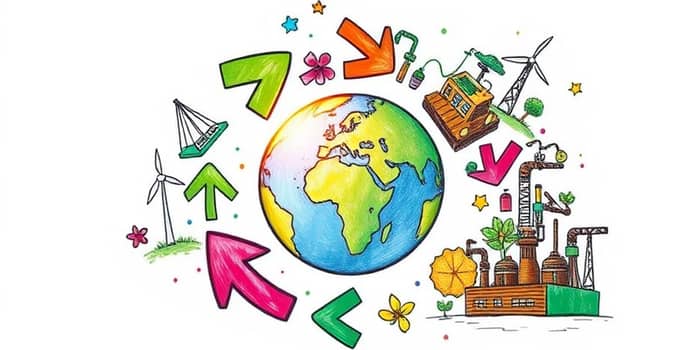
In today's rapidly changing world, the traditional linear economy is proving unsustainable, driving us toward a smarter, more resilient model.
The circular economy represents a profound shift from the take-make-dispose linear model to a system that is restorative and regenerative by design.
This innovative approach not only safeguards our planet but also unlocks lucrative investment opportunities for forward-thinking businesses and communities.
By reimagining how we produce, consume, and reuse resources, we can create a future where economic growth and environmental health thrive together.
Embracing this model means transforming waste into value and fostering innovation at every stage of the supply chain.
The foundation of the circular economy rests on three interconnected principles that guide sustainable practices.
First, it aims to eliminate waste and pollution from the outset, ensuring that products are designed with longevity and minimal environmental impact in mind.
Second, it focuses on circulating products and materials at their highest value through strategies like reuse, repair, and recycling.
Third, it commits to regenerate natural systems, enhancing biodiversity and restoring ecosystems for future generations.
These principles work in harmony to close the loop on resource use, reducing reliance on finite materials.
This holistic framework encourages businesses to think beyond short-term gains and prioritize long-term sustainability.
Adopting circular practices offers immense environmental advantages that combat climate change and resource depletion.
Research indicates that it could halve CO₂ emissions by 2030 compared to 2018 levels, making it a critical tool in global efforts to reduce carbon footprints.
Additionally, it reduces the demand for virgin materials, with studies showing a potential 32% reduction in virgin material demand, thereby conserving natural resources.
Energy efficiency gains are significant, as seen in examples where companies achieve 70-75% solid waste reduction and substantial emission cuts.
For instance, Philips has demonstrated a 28% lower carbon footprint with refurbished medical systems, highlighting tangible environmental progress.
The circular economy is not just an environmental imperative; it's a powerful economic driver that boosts profitability and resilience.
Businesses can realize cost savings by reducing production costs and tapping into new revenue streams from circular activities like recycling and reselling.
Up to 70% material savings can be achieved, mitigating risks from raw material price volatility and supply chain disruptions.
This model fosters innovation, leading to new markets and business models that enhance competitive advantage and customer loyalty.
Philips reported that 9% of their 2016 revenues were circular, with ambitious targets for growth, underscoring the financial viability of this approach.
Real-world examples from diverse industries illustrate how circular strategies can be implemented effectively and scaled for impact.
IKEA's buy-back program encourages customers to return furniture for resale, promoting resource efficiency and customer engagement while reducing waste.
Interface has recovered over 75 million pounds of post-consumer carpet since 2016, transforming materials like fishing nets into new products.
These cases show that circularity is achievable across sectors, from healthcare to manufacturing.
These successes demonstrate that investing in circularity leads to measurable benefits for both the planet and the bottom line.
To harness the power of the circular economy, businesses can adopt practical strategies that align with their operations and goals.
Revenue models such as subscriptions and shared pricing incentivize product longevity and facilitate resource recovery at end-of-life.
Investing in design for durability and repairability ensures that products can be easily maintained, upgraded, and eventually recycled.
Collaboration with stakeholders, including suppliers and customers, is key to creating closed-loop systems that maximize value.
These approaches not only reduce environmental harm but also build stronger brands and customer loyalty through ethical practices.
The circular economy's principles apply to a wide range of industries, from fashion and electronics to food and urban planning.
Governments and cities are increasingly embedding circular strategies into policies, driving systemic change across value chains.
While challenges like initial investment costs exist, the long-term resilience and profitability of circular models outweigh short-term linear gains.
Investment in circular solutions is seen as profitable and essential for market expansion, especially as resources become scarcer.
Looking ahead, the circular economy promises to foster innovation, enhance compliance, and strengthen reputations in an era of increasing environmental awareness.
In conclusion, the circular economy offers a transformative path toward sustainable resource management.
By investing in circular practices, we can create a sustainable and prosperous future that balances economic growth with planetary health.
It's time to embrace this model and turn the challenges of today into opportunities for tomorrow.
References