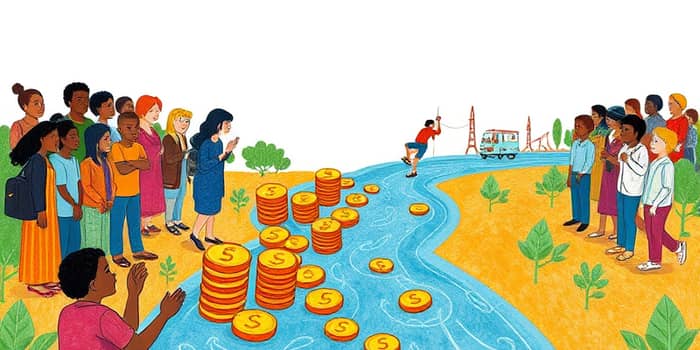
Every year, millions of Americans file their taxes, often with a sense of confusion or frustration. Understanding where your money goes can transform this process into an empowering act of citizenship.
The U.S. tax system is built on principles of fairness and progressivity, ensuring that societal needs are met collectively. This system funds everything from national defense to local schools, weaving the fabric of our daily lives.
With the enactment of the One Big Beautiful Bill Act, key aspects of taxation have been made permanent, affecting brackets and deductions. Staying informed about these changes is essential for financial planning and civic engagement.
The federal tax system is progressive, meaning tax rates increase as income rises. Only the portion of income within each bracket is taxed at that rate, not your entire earnings.
For the 2026 tax year, there are seven marginal tax rates, adjusted for inflation to prevent bracket creep. These rates ensure that taxpayers are not unfairly penalized by economic changes.
Standard deductions provide a baseline reduction in taxable income. For 2026, single filers can deduct $16,100, while married couples filing jointly have a $32,200 deduction.
This table illustrates how the progressive system applies, with higher rates targeting additional income above specific thresholds.
Federal revenue comes primarily from taxes, which totaled about $4.9 trillion in 2022. Individual income taxes and payroll taxes form the bulk of this revenue.
Nearly 90% of tax revenue is derived from individuals through income and payroll taxes, highlighting the system's reliance on working Americans.
Federal spending in FY2024 is projected at $6.8 trillion, with significant portions redistributed to states and localities. This redistribution supports critical programs like Medicaid and education.
Your tax dollars directly impact community health, infrastructure, and social safety nets, making taxation a vital investment in public good.
State and local governments rely on a mix of taxes, federal transfers, and service charges. Property taxes dominate local revenue, while income and sales taxes are key at the state level.
Understanding this layer of taxation helps explain why services vary by location and how local decisions affect your wallet.
The One Big Beautiful Bill Act has made several tax provisions permanent, offering stability for taxpayers. Key changes include the permanence of marginal rates and increased standard deductions.
These adjustments aim to simplify the tax code and provide relief, especially for middle-income families.
Let's walk through a tax calculation for a single filer with $70,000 income in 2026. Using the progressive brackets, we can compute the tax owed step by step.
First, apply the standard deduction of $16,100 to reduce taxable income to $53,900. Then, calculate tax on the remaining amount using the brackets.
Total tax before credits is approximately $6,570. This example demystifies the process, showing how deductions and brackets interact.
For married couples filing jointly, thresholds are higher, such as $24,800 for the 10% bracket, providing benefits for families.
Taxation is more than a financial obligation; it's a collective effort to build a better society. Every dollar you pay helps fund roads, schools, healthcare, and security.
By understanding where your money goes, you can appreciate the role of taxes in maintaining public goods. Stay informed and engaged, as tax policies evolve to reflect societal needs.
Empower yourself with knowledge, and view taxation as an investment in community and national prosperity. Your contributions shape the world around you, making it a place where everyone can thrive.
References