The global transportation sector stands at a crossroads, contributing up to 20% of greenhouse gases while serving as the backbone of modern society. Today, we embark on a journey to understand how cutting-edge technologies, forward-thinking policies, and community action can reshape mobility for a healthier planet and more equitable future.
As cities swell and demand for mobility intensifies, conventional vehicles continue to emit pollutants that degrade air quality and accelerate climate change. Stakeholders across the spectrum agree that minimizing greenhouse gas emissions and environmental impacts is an imperative not just for science, but for public health, economic stability, and social well-being.
Equitable access to clean transportation ensures that low-income neighborhoods see the same benefits of reduced noise, better air, and lower fuel costs as affluent areas. From bustling megacities to rural communities, the shift toward sustainability must be inclusive, affordable, and safe.
Electric vehicles (EVs) have emerged as the linchpin of a greener grid. Global sales have soared from 10 million in 2022 to nearly 14 million in 2023, culminating in over 17 million units in 2024. By the close of 2025, projections exceed 20 million—one in four new cars sold worldwide.
Key drivers include rapid advances in battery chemistry, enhanced energy density, and competitive pricing. In many markets, cost parity or near parity with ICE vehicles has been achieved, removing a major obstacle for mainstream adoption. As consumer confidence grows, the industry is responding with diverse models, from nimble city cars to luxury SUVs, catering to every taste and need.
While the EV revolution accelerates, adoption rates vary widely. Mainland China leads decisively, with new energy vehicles (NEVs) capturing 50% of new car sales in 2025. Europe’s top five markets average 23%, and the United States trails at roughly 10.5% of new sales midyear. Meanwhile, Norway continues to stand out, with adoption rates exceeding 80% thanks to generous incentives and robust charging networks.
Within the U.S., California reigns supreme with over 1.8 million EVs on its roads, thanks to state-level incentives and stringent emissions standards. Yet, nationwide progress underscores that even leading states must continue investing in consumer outreach and infrastructure to maintain momentum.
EV adoption hinges on the availability of reliable charging. Governments and private entities have poured billions into public and residential networks, deploying chargers along highways and in urban centers. These efforts reduce range anxiety and make electric mobility practical for all.
Technological breakthroughs in solid-state batteries promise higher capacity and shorter charging times. At the same time, policy frameworks—ranging from tax credits to low-emission zones—play a vital role in steering consumers toward sustainable choices. By combining expanding and maturing fast-charging networks with targeted incentives, nations can chart a clear path to mass adoption.
The future transport ecosystem extends past battery-powered cars. Autonomous vehicles are breaking from pilot programs into real-world deployments. Logistics companies are testing self-driving trucks on long-haul routes to cut costs, reduce accidents, and address driver shortages. In urban settings, driverless shuttles and buses promise smoother service and lower congestion.
Sustainable freight is emerging as another frontier. Electric delivery vans handle last-mile operations, while hydrogen and liquefied natural gas (LNG) enter mainstream shipping for medium- and long-distance hauls. Airlines, too, invest heavily in Sustainable Aviation Fuel (SAF) to decarbonize the skies.
Meanwhile, autonomous vehicles are reshaping urban mobility, freeing resources for more efficient and responsive networks that adapt in real time to traffic conditions and passenger demand.
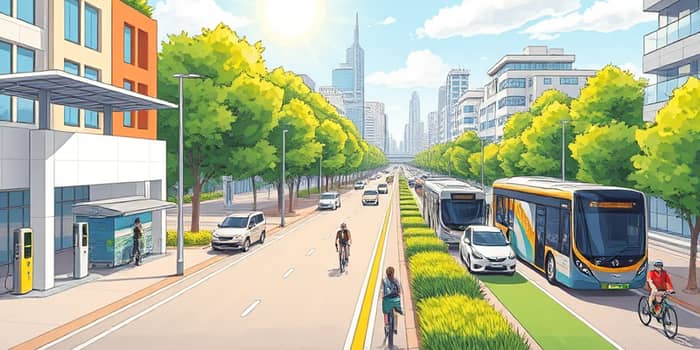
Urban planners envision cities where public transit, bicycles, e-scooters, and ride-sharing coexist seamlessly. Data-driven traffic management, powered by AI and the Internet of Things, optimizes flow and minimizes idling emissions. Pedestrian-friendly zones and micro-mobility hubs put people first, reclaiming streets from congestion and pollution.
Initiatives worldwide support multimodal networks that reduce reliance on private cars. From dedicated bike lanes in Amsterdam to electric bus rapid transit in Bogotá, these projects demonstrate how integrated planning can deliver cleaner air, safer streets, and more livable neighborhoods.
Investments in electric buses and cycling infrastructure not only cut carbon but also foster healthier, more active communities. Equitable mobility solutions ensure that seniors, students, and underserved populations all gain access to opportunity.
The transition to sustainable transportation demands leadership, collaboration, and vision. Policymakers must set clear targets, fund critical infrastructure, and align regulations to encourage innovation. Businesses must commit to greener fleets and transparent reporting, while financiers channel capital into emerging technologies.
Citizens, too, hold power through their daily choices—opting for public transit, car-sharing, or e-bikes. As stakeholders unite, the combined impact ripples outward, cleaning air, reducing carbon, and strengthening economies.
By fostering collaborative efforts among governments, industry, and citizens, we can pave a future where mobility enhances quality of life without compromising our planet. The road ahead is challenging, but every electric mile, every policy breakthrough, and every shared ride brings us one step closer to a truly sustainable grid of movement.
References