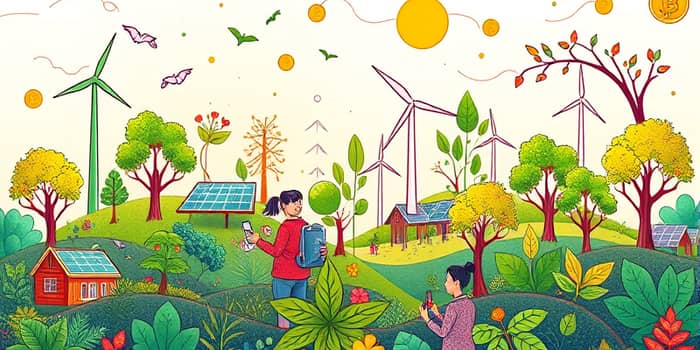
In an era of climate urgency and shifting consumer values, the financial sector stands at a pivotal juncture. Traditional banking and investment models, once solely profit-driven, are now adapting to meet global sustainability targets and stakeholder expectations. Sustainable fintech emerges as a powerful catalyst for change, leveraging advanced technologies to drive sustainable growth trajectory in fintech and deliver solutions that benefit both people and the planet.
By integrating environmental, social, and governance principles into core business strategies, fintech innovators are reshaping how capital flows, how risks are assessed, and how individuals interact with financial services. This movement is not a fleeting trend; it represents a fundamental transformation towards a more responsible and resilient financial system.
Sustainable fintech, often referred to as green fintech, comprises companies and platforms that intentionally minimize negative impacts on the environment and society. These enterprises embed sustainability considerations into every decision, from product design to customer engagement. The goal is to replace less eco-friendly alternatives with offerings that support a low-carbon future.
At its core, this approach combines fintech’s innovative spirit with a deep commitment to sustainability principles, ensuring that financial services deliver positive outcomes for communities, ecosystems, and future generations.
Over the past decade, the fintech industry has experienced explosive growth. Today, it is entering a phase defined by collaboration, mature regulation, and targeted sustainability goals. Investors are increasingly channeling funds into climate-focused fintech startups, recognizing that environmental risks are financial risks.
In 2022, global green investments reached $495 billion, highlighting a rising appetite for products that align capital with climate solutions. As we approach 2025, this trend is expected to accelerate, with green finance becoming a key driver of innovation and competitive differentiation.
As regulatory landscapes tighten, with frameworks like the EU Sustainable Finance Disclosure Regulation (SFDR), transparency and accountability are becoming mandatory rather than optional. Financial institutions that proactively adopt green fintech solutions can gain a first-mover advantage, strengthening trust with stakeholders and avoiding potential compliance costs down the line.
Fintech’s most revolutionary contributions to sustainability can be grouped into several core mechanisms that make impacts tangible and scalable.
These innovations empower businesses and consumers to make informed choices, aligning capital deployment with the transition to a net-zero economy.
The landscape of sustainable fintech is populated with inspiring examples of companies driving real-world impact.
This table illustrates how different instruments translate sustainability performance into financial benefits, bridging the gap between environmental goals and economic value.
As we move deeper into the decade, several trends are poised to redefine sustainable fintech and unlock new avenues for impact.
Open banking frameworks will enable seamless integration of sustainability data, while embedded green features in digital wallets offer personalized eco-budgeting and vendor insights. Eco-conscious cryptocurrencies will experiment with proof-of-stake models to reduce energy demand, and carbon-neutral payment processing will become a standard expectation. Together, these advances will create an ecosystem where every financial interaction carries a measurable environmental footprint.
Organizations seeking to adopt sustainable fintech solutions can follow a structured framework to ensure meaningful progress:
By following these steps, organizations can transform abstract sustainability targets into concrete financial and environmental outcomes.
Sustainable fintech represents a paradigm shift in how we conceive and deliver financial services. By harnessing technology to illuminate environmental impacts, reward positive behavior, and direct capital toward green initiatives, this sector holds the promise of a cleaner, fairer economy. The road ahead will require collaboration among regulators, investors, fintech startups, and traditional banks. Together, we can build a financial system that not only measures success by profit but by its contribution to the planet and society.
As consumers and companies alike demand more from their financial institutions, the innovations outlined here offer a blueprint for progress. Embracing sustainable fintech is not just an ethical imperative—it is a strategic advantage that can drive resilience, innovation, and long-term value in a world increasingly defined by environmental challenges and opportunities.
Together, through innovation and determination, stakeholders can ensure that the financial system not only supports but accelerates the planet’s path to sustainability.
References