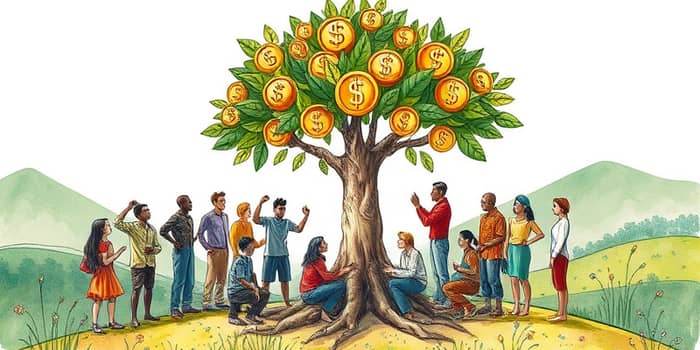
In a world where traditional measures of wealth often ignore ecological limits and social well-being, sustainable capital emerges as a transformative concept. It shifts the focus from endless accumulation to long-term resilience and planetary health, empowering individuals and organizations to pursue financial success in alignment with deeper values.
Many of us experience a persistent misalignment between our income and our values. Conventional growth-driven models reward endless consumption, often at the expense of environmental integrity and social equity. Sustainable capital proposes a new metric: fund a life aligned with ethics. This approach recognizes a “sufficiency threshold,” beyond which additional wealth yields diminishing returns on happiness, yet often creates waste and overconsumption.
By embracing resource sovereignty, we reclaim control over our time and attention, directing them toward pursuits that nourish our communities and natural systems. This shift is not just ethical; it is also pragmatic. As ecological crises intensify, adaptation costs threaten to outpace private wealth, making resilience a vital financial strategy.
At the heart of sustainable capital lies socio-ecological theory and innovative economic frameworks like Doughnut Economics. This model visualizes a safe operating space bounded by a social foundation and an ecological ceiling, ensuring we meet human needs without breaching planetary boundaries. It embodies a balanced human needs and planetary boundaries philosophy.
The Five Capitals Framework further expands this vision by recognizing five forms of wealth: financial, manufactured, human, social, and natural capitals. True sustainability demands we maintain or enhance stocks across all five, rather than focusing solely on financial returns. Corporations such as Honda and Toyota exemplify this by innovating processes that maximize resource efficiency and regenerative impact.
Translating theory into action requires targeted strategies at personal, organizational, and systemic levels. By prioritizing resilience over expansion, each actor can contribute to a robust, equitable economy.
These steps help individuals build a foundation of circular financial mechanisms to eliminate waste and enhance autonomy. By focusing on local ecosystems, people reduce vulnerability to global shocks and cultivate deeper social ties.
Private markets play a crucial role by focusing on risk-adjusted returns and pragmatic impact solutions. These strategies cultivate a business ecosystem driven by stakeholder capitalism and circular economy principles, where value creation extends beyond shareholders to communities and ecosystems.
Honda and Toyota, industry leaders in automotive manufacturing, demonstrate the power of process innovation. By optimizing assembly lines and material reuse, they reduced waste and built resilient supply chains that weather resource scarcity. Their success underscores the importance of optimized allocation of human and planetary capital in driving competitive advantage.
On the financial side, green bonds have funded low-carbon public transport projects in Europe, slashing emissions while delivering stable returns. These instruments illustrate how capital can be redirected to projects that generate both financial profit and measurable environmental impact, reinforcing the triple bottom line.
Despite growing momentum, obstacles remain. A persistent $5 trillion annual investment gap for SDGs highlights the scale of unmet needs. Fragmented taxonomies and reporting standards impede transparent capital allocation. Furthermore, cultural biases favoring short-term gains over systemic resilience can stall progress.
To overcome these hurdles, stakeholders must co-create unified frameworks that standardize metrics and incentivize intergenerational thinking. Governments, corporations, and civil society should collaborate to refine taxonomies, ensuring that sustainable activities receive clear, consistent support from regulators and investors alike.
As millennials and impact investors drive demand for meaningful investments, the landscape is evolving toward pragmatic sustainability. Private markets have a critical window to demonstrate that circular financial mechanisms to eliminate waste can deliver both competitive returns and social good. Success will depend on transparency, accountability, and a shared commitment to regenerative growth.
Individuals can begin by reassessing consumption habits, reducing debt, and channelling investments into local, mission-driven ventures. Businesses must integrate ESG considerations into every layer of strategy, from procurement to performance assessment. Together, these efforts will create a resilient economic model that honors the health of people and planet.
Sustainable capital represents a profound shift in how we define and pursue financial success. By embracing resource sovereignty, aligning with planetary limits, and embedding social value into every investment decision, we can build an economy that nurtures well-being for current and future generations. The journey demands bold leadership, collective action, and a willingness to redefine prosperity. Let us seize this moment to create a legacy of abundance that respects the intricate web of life on Earth.
References