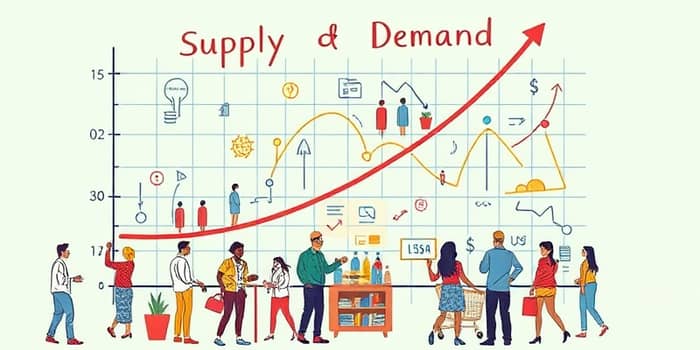
Every day, from the coffee you buy to the rent you pay, prices shape your world in profound ways. Understanding the invisible forces behind these numbers can transform confusion into clarity and empower your financial choices.
At its heart, the dance of supply and demand dictates market outcomes, influencing everything from global economies to personal budgets. This fundamental principle is not just theory; it's a powerful lens through which to view the world.
By grasping how market equilibrium emerges from this interplay, you can anticipate changes and make smarter decisions, whether you're a consumer, investor, or entrepreneur.
The concept is simple yet profound: when buyers and sellers interact, they create a price that balances their interests. This balance point, or equilibrium price, is where supply meets demand, ensuring that markets function smoothly.
Visualizing these curves on a graph helps demystify complex economic interactions, making abstract concepts tangible and actionable.
The demand curve represents consumer behavior, sloping downward to show that higher prices reduce the quantity demanded.
This is the law of demand: as price increases, people buy less or seek alternatives, driven by budgets and preferences.
Conversely, the supply curve slopes upward, illustrating the law of supply where producers offer more at higher prices to maximize profits.
When these curves intersect, they create the equilibrium price, where supply equals demand and the market clears efficiently.
This intersection is not static; it shifts with changes in consumer tastes or production costs, highlighting the dynamic nature of markets.
At equilibrium, no shortage or surplus exists, but markets are dynamic and constantly adjusting to changes.
This self-correcting mechanism ensures that prices tend to stabilize over time, unless persistent shifts occur.
For example, in a free market for apartments, setting supply equal to demand solves for the equilibrium price: if supply is 50 + 5P and demand is 100 - 5P, then P = $500, balancing the market.
This numerical example shows how equilibrium can be calculated, providing a practical tool for analysis.
Elasticity measures how sensitive quantity is to price changes, explaining why some goods see volatile prices while others remain stable.
Price elasticity of demand (PED) is calculated as the percentage change in quantity demanded divided by the percentage change in price.
Determinants of demand elasticity include:
Price elasticity of supply (PES) gauges producer responsiveness, with inelastic supply in short-run scenarios like agriculture due to fixed resources.
Determinants of supply elasticity include:
This table highlights how elasticity varies across products, affecting market stability and guiding policy decisions.
Understanding these variations can help you predict price movements and adjust your strategies accordingly.
Governments often intervene with price controls, such as price ceilings to make goods affordable, but these can lead to shortages if set below equilibrium.
In everyday life, businesses use elasticity to test pricing strategies.
For instance, a bakery might raise bread prices from $5 to $6 to gauge consumer response and optimize profits.
Uber's surge pricing is a modern example of adjusting prices in real-time based on demand shifts, showcasing dynamic market mechanisms.
These applications demonstrate how theory translates into practice, empowering you to navigate economic landscapes.
Demand can shift due to factors like income changes, consumer tastes, or population growth, altering the entire curve and equilibrium.
Understanding these shifters helps explain sudden price changes, such as during economic crises or technological breakthroughs.
For example, a decrease in production costs can shift supply rightward, lowering prices and increasing quantity, benefiting consumers.
This knowledge allows you to anticipate trends and adapt to market fluctuations with confidence.
Mastering supply and demand equips you with a toolkit to navigate markets, from personal spending to investment opportunities.
By recognizing equilibrium as a balancing act, you can anticipate trends and avoid common pitfalls in financial decisions.
Embrace this knowledge to make informed choices, fostering resilience and success in an ever-changing economic landscape.
Start applying these principles today: observe price changes in your daily life, analyze the underlying supply and demand factors, and use this insight to enhance your economic well-being.
With this foundation, you can transform uncertainty into opportunity, driving your personal and professional growth forward.
References