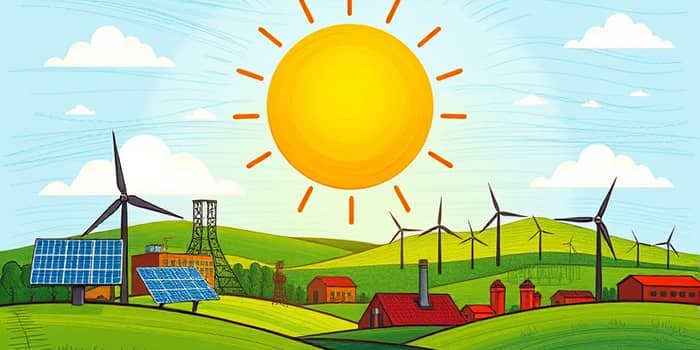
In 2025, our world finds itself at a pivotal crossroads in the energy sector. We are witnessing record-breaking investment levels that are not only reshaping the global energy landscape but also galvanizing communities, industries, and governments to embrace transformative change. From sprawling solar farms in sun-drenched deserts to sleek, modern wind turbines spinning gracefully along coastlines, the vision of a cleaner, more resilient future is taking tangible form. This movement is more than a financial shift2D2Dit is a testament to human ingenuity, resilience, and the collective will to secure a sustainable legacy for generations to come.
Global energy investment is projected to soar to an unprecedented $3.3 trillion in 2025, underscoring a fundamental transition in capital flows. Of this staggering sum, approximately $2.2 trillion will be channeled into clean technologies, a figure that is more than twice the investment devoted to fossil fuels. This realignment not only reflects growing environmental awareness but also signals confidence in renewable technologies as drivers of long-term economic growth and energy security.
At the forefront of this revolution, solar photovoltaic (PV) systems have emerged as the technology capturing the most capital worldwide. Combined spending on utility-scale and rooftop solar is expected to reach $450 billion, making it the largest single category in the International Energy Agency's 2025 spending inventory. This surge illustrates the accelerating pace at which clean electricity generation is replacing traditional carbon-intensive sources.
In the United States, clean energy and transportation investments reached $67.3 billion in Q1 2025, a 6.9% increase from the previous year. Yet this period also brought a 3.8% decline from Q4 2024, highlighting both the momentum and the headwinds facing the market. Policymakers and investors alike are grappling with the effects of the One Big Beautiful Bill Act, which rolled back key tax credits and introduced new restrictions that have weighed on wind and solar project financing.
Despite these challenges, clean investment continues to command a significant share of private capital, accounting for 4.7% of all private spending on structures, equipment, and durable goods. The resilience of this sector reflects the deep-seated demand for sustainable energy solutions and the long-term conviction among stakeholders that the clean energy transition is not a passing trend, but a strategic imperative.
Understanding how clean energy funds are allocated across various segments is essential for grasping the full picture. In Q1 2025, investment streams in the United States demonstrated divergent trajectories, influenced by consumer preferences, manufacturing capacity, and policy shifts.
This breakdown reveals the pivotal role of retail consumers in driving clean investment, nearly half of total spending, and underscores the ongoing evolution of manufacturing and industrial decarbonization efforts.
The project pipeline for renewable energy offers a window into the future trajectory of the sector. In Q1 2025, new utility clean electricity project announcements totaled $41.3 billion, much of which2D2D$36.5 billion2D2Dwas earmarked for solar and storage initiatives. These figures signal solar photovoltaic systems leading globally, but also reflect mixed signals from project pipeline in some segments.
Manufacturing pipeline activity highlights a renewed focus on the EV supply chain, with 75% of new projects dedicated to electric vehicle components. This pivot underscores the interconnected nature of the clean energy ecosystem, where advances in one domain support growth in others.
Since the enactment of the Inflation Reduction Act in Q3 2022, the United States has witnessed an extraordinary infusion of capital and human capital development. More than $321 billion has been invested in manufacturing, clean electricity, and industrial facilities, resulting in the opening of 2,369 new facilities nationwide and the creation of nearly 50,000 operational jobs in four key states:
This robust growth not only injects vitality into regional economies but also establishes a skilled workforce ready to tackle the challenges and opportunities of the clean energy era.
Despite the undeniable progress, the sector faces headwinds that require strategic navigation. Rolling back tax credits and policy uncertainty have led to project cancellations and slowed deployment. Additionally, upcoming Foreign Entity of Concern sourcing rules threaten to disrupt supply chains, particularly in solar and battery components linked to certain foreign nations.
To mitigate these risks, investors and developers are recalibrating their approaches. Financial buyers have shifted toward strategy shifts toward platform acquisitions, consolidating assets to secure scale and expertise. Meanwhile, companies are diversifying supply chains and exploring small modular reactors in the nuclear space, seeking to balance risk with innovation.
As we look ahead, the renewable energy sector stands at the threshold of unprecedented opportunity. With an outstanding pipeline of $522 billion in announced projects and another 187 GW of storage capacity under development, the momentum is unmistakable. These endeavors, driven by collective will and technological innovation, promise to redefine how we power our homes, industries, and transportation networks.
Ultimately, the shift toward renewables is more than an economic phenomenon; it is a moral commitment to safeguard our planet and uplift communities. By harnessing the power of sunlight, wind, and innovation, we can forge a path toward cleaner air, resilient infrastructure, and shared prosperity. The journey ahead may be complex, but with sustained investment, collaboration, and visionary leadership, the promise of powering a sustainable tomorrow is within our grasp.
Let us embrace this era of transformation and invest in a future where clean energy fuels not only our grids but also our hopes, dreams, and collective well-being.
References