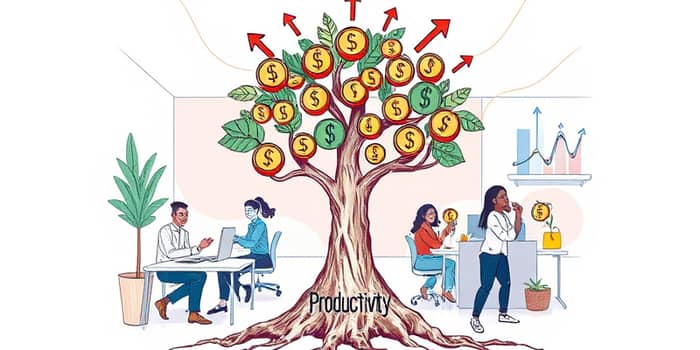
In an ever-evolving economy, productivity stands as the unsung hero behind every paycheck and economic boom. Productivity measures output relative to inputs, and its influence stretches from individual livelihoods to global prosperity.
Understanding this concept is the first step toward unlocking a future of higher wages and sustained growth. It's the engine that powers progress in ways we often overlook.
By exploring how productivity works, we can inspire action and practical change. The primary long-term driver of economic growth lies in maximizing efficiency with what we have.
At its core, productivity is about doing more with less, whether in time, resources, or effort. It's a measure that determines how effectively inputs are converted into valuable outputs.
This concept is crucial for businesses, workers, and policymakers alike. Different metrics help us gauge productivity in various ways.
For example, if a country's GDP is high relative to hours worked, it signals a productive workforce. Higher productivity enables wage growth by reducing costs and boosting output potential.
Productivity growth directly translates into better pay for workers. When output per hour increases, companies can afford to raise wages while maintaining profitability.
This relationship is the backbone of fair compensation in modern economies. Stagnation in productivity often leads to lower average wages and economic inequality.
Real wages have historically moved in tandem with productivity gains. Labor productivity is the biggest determinant of long-term wage growth, shaping living standards over decades.
Key statistics show that workers producing more value per hour can earn significantly more. This empowers individuals and fuels consumer spending.
Productivity is the primary engine for long-term economic expansion and improved living standards. Without it, adding more labor or capital yields diminishing returns.
As Paul Krugman noted, productivity is almost everything in the long run. It drives GDP growth by making better use of existing resources.
Sustained productivity gains are essential for offsetting challenges like aging populations. Economic success hinges on productivity to achieve goals like net-zero emissions.
Future growth depends on continuous productivity improvements. This ensures resilience in the face of global shifts and demands.
Recent data highlights both progress and challenges in productivity trends. In the US, post-WWII averages show consistent growth with recent upticks.
Since 2019, productivity has seen a modest increase, with 2024 marking one of the highest rates in years. This trend offers hope for economic recovery and wage boosts.
Globally, productivity gains have driven a sixfold expansion of the world economy. Productivity growth enables higher wages and economic stability across borders.
These trends underscore the dynamic nature of productivity in shaping economies. They provide a roadmap for where focus is needed most.
Various factors drive productivity changes, from innovation to economic cycles. Understanding these can help harness their power for positive outcomes.
Innovation, especially through technologies like generative AI, offers significant boosts. Capital investment and labor supply recovery also play critical roles.
However, challenges such as declining dynamism and sectoral shifts can slow progress. Innovation and tech are key boosters for sustained productivity gains.
Addressing these elements requires targeted strategies. Investing in education and technology can mitigate risks and enhance efficiency.
Productivity growth extends beyond economics to touch every aspect of society. It fosters financial stability, reduces inequality, and promotes mass flourishing.
Firms benefit from higher profits and global competitiveness. Economies see lower inflation and poverty reduction through increased investment.
Society gains from grassroots dynamism and improved social cohesion. Higher profits and global competitiveness emerge from productive practices.
Risks of stagnation include eroding living standards and economic trouble. Prioritizing productivity is essential for a resilient future.
Productivity is not just a metric; it's a pathway to prosperity for all. By focusing on efficiency and innovation, we can drive wage growth and economic expansion.
Embracing tools like AI and fostering competitive markets will be key. Every individual and organization has a role to play in this journey.
Let's commit to understanding and enhancing productivity in our daily lives. Together, we can build a future where growth benefits everyone.
References