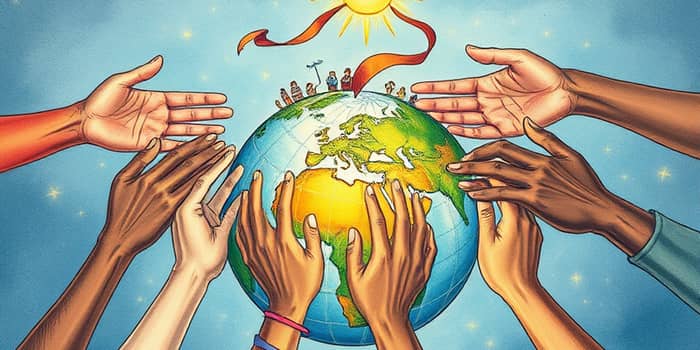
In an era of unprecedented challenges and opportunities, the synergy between philanthropy and finance has emerged as a powerful force for good. This article delves into the vast scale of giving, the innovations propelling social change, and the strategic steps needed to harness billions effectively.
Today, the global philanthropy ecosystem represents a truly staggering financial footprint. With an estimated 4 trillion USD ecosystem, or roughly 4% of global GDP, charitable giving in its many forms—cash, in-kind contributions, volunteer time—touches every corner of the world. Individuals, corporations, foundations, and faith-based institutions have joined forces to address poverty, health crises, education gaps, and more.
Cross-border flows alone highlight the magnitude of this movement. In 2020, countries covered by the Global Philanthropy Tracker contributed a combined USD 70 billion in philanthropic outflows, and when paired with official development assistance, remittances, and private capital investment, total cross-border resources reached USD 841 billion. High-income nations accounted for an astounding 95% of those outflows, yet emerging economies are rapidly increasing their share.
The United States leads global giving with over USD 557 billion donated in 2023. Meanwhile, foundations across 23 countries hold nearly USD 1.5 trillion in assets, distributing more than USD 150 billion annually. These figures illustrate not only generosity at scale but also the growing institutionalization of philanthropy. Zakat alone in Muslim-majority regions Zakat generates up to 600 billion annually, further weaving faith-driven giving into the global tapestry.
The fusion of financial tools and philanthropic intent has given rise to novel approaches that multiply impact. Traditional grants now share the stage with market-based solutions designed to deliver social returns alongside financial discipline.
In North America alone, funding for philanthropy-focused companies reached USD 102.5 billion by 2023, with Financial Inclusion leading with Financial Inclusion led with 40% of that total. This trend underscores how commercial capital and philanthropic insight are converging to solve complex global challenges.
The last five years have accelerated shifts in giving patterns, driven by crises like the COVID-19 pandemic, heightened awareness of social injustice, and the urgent threat of climate change. Digital adoption soared, enabling donors to give in real time during disasters and to follow impact metrics online.
Women are also reshaping the sector. Projected to inherit 70% of private wealth by 2035, women often favor unrestricted grants and support multiple causes, amplifying their influence across fields.
Geographically, the landscape is diversifying. Africa remains the top destination for cross-border philanthropy, followed by Asia, with recipient nations in Europe and Latin America seeing significant upticks. Domestic giving in China and Mexico now rivals or exceeds their international outflows, highlighting a shift towards locally led philanthropy.
While the momentum is encouraging, significant barriers remain. Data gaps hinder evidence-based decision making, tax and regulatory frameworks vary widely, and cultural factors from trust levels to philanthropic norms affect participation.
To unlock further potential, stakeholders have proposed:
By addressing these hurdles, governments and philanthropic bodies can ensure that more resources flow to communities most in need, magnifying the reach and effectiveness of every dollar given.
The coming decade promises even greater alignment between capital markets and social good. Projections estimate charitable spending could double to USD 64 trillion as global wealth grows and giving habits evolve. A modest 0.5% efficiency gain in operations could unlock an additional USD 319 billion annually, channeling that capital into life-changing programs.
As philanthropy becomes increasingly industrialized—with AI-driven decision support, outcome-based funding models, and integrated ESG frameworks—it stands on the brink of redefining its role in a post-aid world. No longer a mere supplement to government assistance, strategic giving is poised to lead solutions on climate resilience, health equity, education access, and beyond.
Now is the moment for donors, financial institutions, policymakers, and nonprofit leaders to forge deeper alliances, embrace innovation, and commit to transparent, data-driven action. In doing so, they will not only bridge the gap between philanthropy and finance but also light the way toward a more equitable, resilient, and hopeful global future.
References