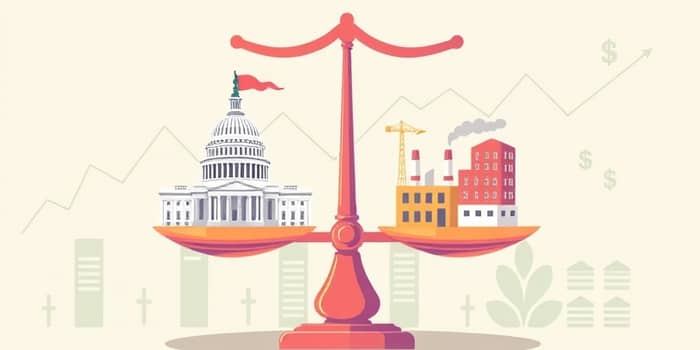
Government spending is a powerful force that shapes economic destinies, driving growth through strategic investments while posing risks of inefficiency and debt.
Understanding its dual role is essential for policymakers and citizens alike, as it influences everything from job creation to long-term prosperity.
The impact of fiscal policy extends beyond immediate stimulus, affecting private investment and wealth effects in profound ways.
At its core, government spending operates through key mechanisms that can either boost or hinder economic performance.
One primary channel is aggregate demand stimulation, where increased public expenditure injects money into the economy.
This spurs consumption and production, often measured by fiscal multipliers that quantify GDP rises per dollar spent.
However, this stimulation can come at a cost, leading to crowding out of private sector activity.
Higher taxes or debt reduce available capital for businesses, stifling innovation and growth over time.
To illustrate these mechanisms, consider the following factors.
These elements interact in complex ways, shaping economic outcomes based on policy choices.
Numerous studies have documented the inverse relationship between government spending and economic growth.
For instance, research shows that a 10% increase in the expenditure ratio can lower annual growth by 0.7 to 0.8 percentage points.
This table summarizes key findings from various studies, highlighting the nuanced impacts.
Key takeaways from empirical studies include crucial insights for economic planning.
Historical data from the 1980s U.S. supports this, where spending above 50% of GDP was linked to stagnation.
In contrast, periods of reduced spending, such as the drop from 52.3% to 37.7% in GDP from 1987 to 1996, correlated with boosted growth.
In the current context, U.S. government spending continues to play a pivotal role.
Projections for 2025-2026 show volatile effects, with the Hutchins Center Fiscal Impact Measure providing detailed insights.
Fiscal policy added 0.4 points to GDP growth in Q3 2025, driven by consumer and government spending.
However, Q4 2025 is projected to see a drag of 1.3 points, largely due to a government shutdown.
Key drivers include several factors that shape quarterly economic performance.
For 2026, growth is expected to range from 0.8% to 2.3%, with spending tailwinds offset by drags.
This highlights the delicate balance in fiscal management required to sustain growth.
Beyond the U.S., government spending trends vary across regions, offering comparative insights.
In Canada, increased infrastructure and defense spending are spurring growth, but debt-service strains pose challenges.
Emerging markets show resilience with subnational spending contributing to 6.8% GDP growth.
China's government spending has driven growth, though it's moderating to 4.5% amid property sector issues.
The euro area faces fiscal consolidation efforts, balancing tax increases with spending cuts.
Notable trends in 2026 include diverse approaches to fiscal policy worldwide.
Globally, growth is projected at 3% to 3.2%, with government spending remaining influential in many areas.
For individuals and businesses, understanding these dynamics can inform financial decisions and advocacy.
Policymakers must weigh the benefits of stimulus against the risks of long-term debt accumulation.
Reduced private sector vitality can emerge from poorly managed fiscal expansions, necessitating careful oversight.
Recent debates center on measures like the OBBBA tax cuts and tariffs, which have mixed effects on growth.
To navigate this, consider the following actionable insights for sustainable economic management.
Ultimately, government spending is not inherently good or bad; its impact depends on how it is deployed.
By fostering a nuanced understanding, we can champion policies that drive sustainable growth and shared prosperity.
The journey toward economic resilience requires thoughtful fiscal stewardship and informed public discourse.
References