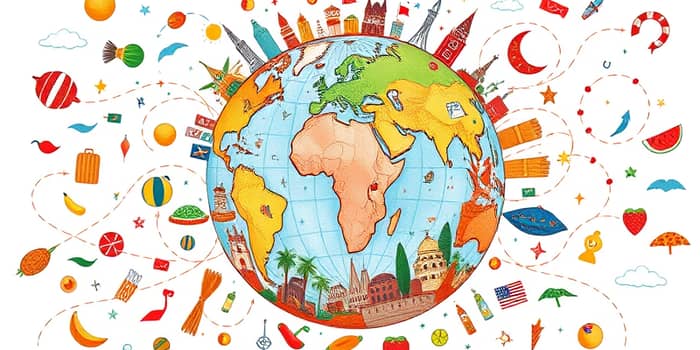
In an age where borders blur and connections deepen, understanding how global forces intertwine with local realities has never been more critical. This article delves into the dynamic relationship between globalization and localization, offering insights and practical guidance for businesses, communities, and policymakers navigating today’s complex markets.
Globalization is the driving force behind the seamless flow of goods, services, information, and capital across borders. Through unprecedented market interdependence, companies can reach consumers on every continent.
This process is propelled by free trade agreements, integrated supply chains, and digital technologies that shrink distances. Multinational corporations leverage shared global standards to achieve efficiency and economies of scale, enabling rapid expansion and innovation.
Over the past decade, global GDP grew from $89.6 trillion in 2010 to an estimated $149 trillion by 2021, illustrating how interconnected markets drive prosperity. Thought leaders like Mahatma Gandhi cautioned that such flows must be guided by ethical considerations to ensure equitable benefits.
Localization transforms global offerings into culturally resonant experiences. By tailoring products, services, and communications to the unique preferences of each region, organizations cultivate authentic customer connections.
Adaptations can range from translating content into local dialects to modifying product features for regional tastes. Payment methods, date formats, and imagery are adjusted to align with regional regulations and customs, ensuring acceptance and loyalty.
In practice, localization extends beyond language to encompass local partnerships, market research, and community engagement. This approach fosters sustained customer loyalty and trust by showing respect for regional identities.
Glocalization represents the convergence of universal reach and cultural specificity. Companies that embrace this approach enjoy the dual benefits of broad exposure and deep market penetration.
McDonald’s famous menu adaptations—serving teriyaki burgers in Japan and masala wraps in India—exemplify how integrating local flavors into global brands leads to sustainable consumer engagement.
This hybrid strategy fosters a sense of global citizenship while honoring local traditions. It empowers consumers to feel part of a global brand story that also reflects their unique identity.
Successful market entry often follows a three-stage pathway: internationalization, globalization, and localization.
By planning for localization during the initial design phase, businesses can avoid costly retrofits and accelerate time-to-market in diverse regions. Early integration of translation management systems and modular interfaces streamlines this journey.
While globalization can foster cross-cultural exchange, it also risks eroding local traditions through homogenization. Localization acts as a counterbalance, preserving heritage by embedding local values into global operations.
Politically, integrated markets encourage trade agreements and reduce barriers, but they also invite complexities such as tariffs and regulatory discrepancies. Automakers entering European markets often adjust safety features and emission controls to comply with EU standards, exemplifying how regulatory adaptation drives acceptance.
Environmentally, global supply chains can strain resources and raise carbon footprints. However, by sourcing locally—parallel to localization efforts—companies can minimize environmental impact and support sustainable community development.
As organizations navigate the interplay of global and local forces, several challenges and emerging trends demand attention:
Efficiently coordinating time zones, remote teams, and cross-cultural communication remains a hurdle. Companies must invest in robust workflows and provide training that spans languages and cultural contexts.
Looking ahead, digital transformation will continue reshaping globalization and localization. Advanced analytics and AI-driven insights will enable hyper-personalized experiences at scale, while remote collaboration tools will connect talent across continents more effectively.
To harness the full potential of globalization and localization, consider the following actionable steps:
Establish clear guidelines for brand voice that accommodate regional expressions without losing your core identity. By weaving localization into every stage—from ideation to delivery—companies can build resilient and adaptive business models primed for diverse markets.
Globalization offers a powerful framework for expansion, innovation, and efficiency, but it cannot succeed in isolation. Localization imbues global strategies with cultural relevance and trust, creating stronger ties with consumers.
Glocalization, the art of blending universal reach with local insight, represents the future of competitive advantage. Organizations that master this balance will lead in an increasingly interconnected world, driving economic growth while celebrating the rich tapestry of global cultures.
References