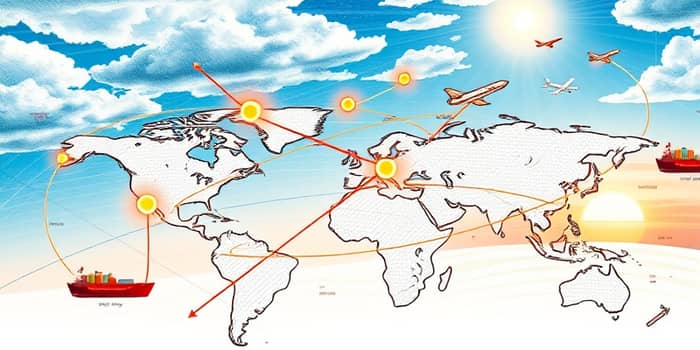
The world of trade is evolving at a breathtaking pace.
In 2025, global commerce achieved a historic milestone that reshaped economic landscapes.
This growth was driven by higher volumes rather than price increases, signaling robust demand.
Understanding these dynamics is crucial for businesses and policymakers alike.
This article delves into the latest trends and offers practical guidance.
Global trade reached an astounding $35 trillion in 2025.
This represented a growth of about 7% from the previous year.
The increase added approximately $2.2 trillion to the global economy.
Goods trade contributed $1.5 trillion to this expansion.
Services trade added another $750 billion, showing nearly 9% annual growth.
Between July and September 2025, trade grew by 2.5%.
This period saw goods trade up by 2% and services by 4%.
The first half of 2025 witnessed goods trade rising 6% year-over-year.
Trade growth outpaced global GDP, which was projected at 2.6% in 2025.
This reversed the stagnation seen in 2023-2024, marking a significant recovery.
Key factors behind this surge include increased manufacturing and digital services.
AI and electronics demand played a pivotal role in this acceleration.
Looking ahead, growth is expected to slow sharply to 0.6% in volume terms.
This is down from 2% in 2025, according to UNCTAD forecasts.
Weaker global activity, with GDP growth at 2.6%, is a primary driver.
Rising debt levels and higher trade costs add to the uncertainty.
Underlying trade growth is estimated at 2.5-3% without temporary boosts.
Factors like pre-tariff imports and AI contributions will fade.
Businesses must prepare for this deceleration by optimizing strategies.
Focusing on efficiency and resilience will be key in the coming year.
Regional performances varied significantly from Q4 2024 to Q3 2025.
East Asia emerged as the strongest region with export growth of 9%.
Intra-regional trade in East Asia increased by 10%, led by China and South Korea.
Africa showed solid growth with imports up 10% and exports up 6%.
South Africa was a key driver in this region.
South-South trade grew by 8%, highlighting resilience among developing economies.
South America saw intra-regional trade rise by 7% over four quarters.
Europe maintained steady exports at 6% and imports at 8% growth.
North America experienced slower export growth at 2%, with a dip in Q3.
Here is a summary table of regional trade growth:
This table helps visualize the disparities and opportunities across regions.
Different sectors showed varied performance during this period.
Manufacturing led with a 10% increase, driven by electronics and AI demand.
Electronics alone saw a 14% surge due to rising AI applications.
Agriculture also performed well, growing by 6% over four quarters.
Key sub-sectors included cereals, fruits, and vegetables with 11% growth.
Oilseeds and oils increased by 9%, benefiting from stable supply chains.
The automotive sector declined by 4%, with hybrid vehicles up 22%.
Combustion vehicles dropped 13%, while EVs saw a 5% decrease.
Energy and fossil fuels declined due to lower prices and shifting demands.
Commodities like iron and steel surged by 40%, showing volatility.
Natural resources remained subdued, impacting certain economies.
Financialization highlights that over 90% of global trade relies on trade finance.
For major food traders, more than 75% of income comes from financial operations.
Several challenges threaten to disrupt trade flows in the near future.
Geopolitical fragmentation continues to create tensions and trade disputes.
Rising tariffs are reshaping global flows and increasing costs.
Debt pressures in developing economies pose a significant risk.
Market volatility leads to higher costs and uneven demand patterns.
Over 90% of trade finance is sensitive to interest rate changes.
Investor sentiment can quickly alter trade dynamics and accessibility.
The US-EU deal has eased some uncertainty but drags on investment.
Consumer sentiment remains cautious, affecting long-term growth.
Insolvencies are expected to rise in the US and China as tariffs fade.
This could lead to an 8% increase in the US and 10% in China.
Businesses must stay agile to navigate these persistent risks.
Amid challenges, numerous opportunities await proactive players.
South-South trade resilience offers a buffer against global slowdowns.
Emerging markets like India and China are leading in services exports.
The AI and digital economy are fueling manufacturing innovations.
Hybrid vehicles present a growth niche within the automotive sector.
Agriculture surges provide stability and potential for expansion.
Intra-regional trade in East Asia and South America is strengthening.
Friendshoring and nearshoring are becoming more prevalent strategies.
These approaches focus on politically aligned or geographically close partners.
They help mitigate risks and enhance supply chain reliability.
Leveraging these trends can unlock new markets and efficiencies.
To capitalize on these dynamics, businesses can adopt several strategies.
Additionally, consider the following actions:
These steps can help navigate the complex trade landscape effectively.
Global trade in 2025 set new records, but 2026 brings slower growth.
Regional and sectoral shifts offer both challenges and opportunities.
By understanding these dynamics, businesses can position for success.
Embracing innovation and resilience will be key to thriving.
The future of trade is bright for those ready to adapt and lead.
References