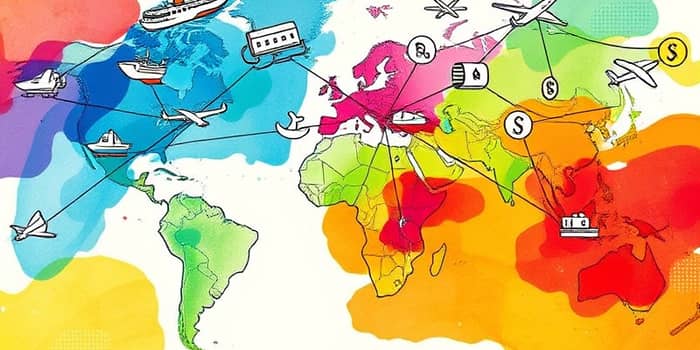
In an interconnected world, global trade has become the lifeblood of economies, driving innovation and prosperity across borders.
Global trade reached a record $35 trillion in 2025, marking a historic milestone that underscores its expanding influence.
This growth is not just about numbers; it reflects a dynamic shift where services comprise 27 percent of global trade, outpacing goods and reshaping traditional models.
The sheer volume of trade today is staggering, with every transaction weaving a complex web of global interdependence.
From the surge in South-South trade surged from $0.5 trillion to $6.8 trillion in merchandise exports, developing economies are now major players.
This transformation is powered by digital advancements, where digitally deliverable services account for over half of services exports, bridging distances instantaneously.
To illustrate key statistics, here is a snapshot of recent trends:
These figures reveal a world where trade is not just growing but evolving in profound ways.
Global trade offers a pathway to shared prosperity, unlocking opportunities that extend far beyond mere commerce.
It drives economic growth and efficiency by enabling countries to specialize and access larger markets, reducing costs for consumers.
For emerging economies, trade fosters technology transfer and job creation, lifting communities out of poverty through increased investment.
Key benefits include:
These advantages make trade a powerful tool for sustainable development and global stability.
Despite its benefits, global trade faces significant hurdles that require careful management and strategic foresight.
Geopolitical tensions and protectionism are rising, with U.S. tariffs at their highest since the 1930s, creating uncertainty.
This environment can lead to economic slowdown and digital divides, where disparities in digital exports widen gaps between nations.
Major risks to consider:
Addressing these challenges is essential for maintaining a fair and functional trading system.
Understanding the foundational ideas behind global trade can empower businesses and policymakers to make informed decisions.
Global value chains reshaping via digital and green transitions highlight how production is distributed across borders.
Similarly, protectionism used strategically in trade policies reflects shifting geopolitical aims and economic priorities.
Essential concepts include:
Grasping these concepts helps navigate the complexities of modern trade dynamics.
Looking ahead to 2026, global trade is poised for continued evolution, with both opportunities and obstacles on the horizon.
Slower growth and fragmentation are expected, as economic forecasts project modest GDP increases amid global uncertainties.
Yet, tech boom chips and EVs offer bright spots, with sectors like AI and critical minerals set to expand rapidly.
Key trends to watch:
These trends underscore the need for agility and collaboration in the coming years.
To thrive in this dynamic landscape, stakeholders can adopt actionable approaches that leverage benefits while mitigating risks.
Start by diversifying supply chains and investing in digital infrastructure to enhance resilience and access new markets.
Focus on building regional partnerships and embracing sustainable practices to align with global trends and consumer demands.
Practical steps include:
By implementing these strategies, businesses and economies can navigate trade complexities with confidence and purpose.
In conclusion, global trade stands at a crossroads of immense potential and challenge.
Embracing its benefits while addressing risks requires a proactive and informed approach, fostering a world where commerce connects us all toward shared prosperity.
References