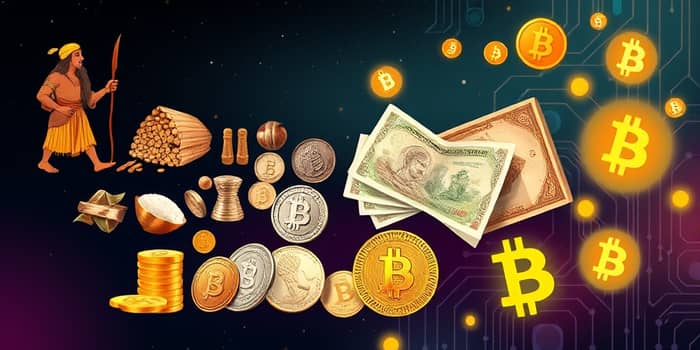
Money has shaped civilizations, fueled empires, and connected distant cultures. Its journey from simple exchanges of goods to complex digital assets reveals human creativity, adaptation, and the relentless pursuit of trust. As we trace this evolution, we uncover lessons that resonate in today’s financial world.
Across millennia, societies have overcome challenges of value, security, and portability to invent new forms of currency. Each breakthrough—whether metal coins or blockchain networks—reflects a desire to simplify trade and safeguard wealth. This narrative unites ancient markets and modern digital ledgers in one sweeping story.
The earliest economic interactions were direct exchanges of goods. In Mesopotamia around 6000 BC, tribal communities traded grain, livestock, and crafted tools. Phoenician merchants voyaged across the Mediterranean, swapping timber and wine for exotic spices.
Barter’s simplicity masked profound limitations. Without a common measure of value, negotiators faced endless haggling over relative worth. Many commodities were indivisible or perishable, and transporting bulky items across long distances proved onerous.
By 3000 BC, Mesopotamian merchants recorded debts on clay tablets, using pictograms of barley and livestock. These symbolic records laid the groundwork for abstracting value—a fundamental shift toward true currency.
As trade networks expanded, certain goods gained universal acceptance as stores of wealth. Cattle, prized for their reproductive potential, lent their name to the Latin term pecunia. Salt preserved food and appeared in Roman soldiers’ early salary payments.
Despite their appeal, commodity monies fluctuated in value. Crop failures, disease outbreaks, or changes in supply led to volatility. Their bulk and perishability still hindered accumulation of large fortunes.
Metals offered a breakthrough: they were durable, divisible, and portable. Initially traded as raw lumps and bracelets, they required weighing and assaying for each transaction. Around 2150 BC, the Mesopotamian shekel emerged—a unit of barley weight that standardized metal transactions.
By 1000 BC, China produced bronze cowrie imitations as the first metal coins. In the 7th century BC, Lydia minted electrum ingots—an alloy of gold and silver—bearing official stamps. These marks guaranteed weight and purity, inspiring trust in distant markets.
By 500 BC, Greece and Persia refined coinage into round silver pieces impressed with images of gods and rulers. Coins not only facilitated trade but also broadcast political power and cultural identity. Durable symbols of authority and value spread across the known world.
Heavy metal coins posed new challenges as trade flourished. In Tang Dynasty China (618–907 AD), merchants carried promissory notes instead of large copper coins. These deposit receipts evolved into official government-issued paper money by the Song Dynasty (11th century).
China’s success inspired imitation abroad. In medieval Europe, goldsmiths held deposits and issued receipts that circulated as currency. The battle against forgery spurred advanced printing techniques and watermarks—early countermeasures shaping modern banknote security.
Medieval goldsmith banks became the forerunners of today’s central banks. By safeguarding precious metals and issuing redeemable receipts, they enabled larger-scale lending and investment.
In 1816, Britain adopted the gold standard, tying banknote issuance to fixed gold reserves. The U.S. followed with the 1900 Gold Standard Act. This system anchored currency values but limited monetary policy flexibility. The perception of stability rested on gold-backed stability of modern economies.
By the mid-20th century, nations shifted to fiat currencies—notes and coins whose value stemmed from government decree rather than intrinsic metal content. Central banks gained broad authority to manage money supply, respond to crises, and guide economic growth.
Advances in printing and materials fortified banknotes against counterfeiting. Microprinting, holograms, and polymer substrates became standard. Meanwhile, electronic transfers, credit cards, and mobile payments dematerialized money further.
In 2009, Bitcoin emerged as a revolutionary digital asset based on a groundbreaking immaterial blockchain ledger. Decentralized and borderless, it challenged traditional notions of trust and central authority. Today, countless cryptocurrencies and digital central bank initiatives carry this legacy forward.
Understanding money’s journey empowers us to navigate modern finance. From the pitfalls of barter to blockchain’s promise, history teaches resilience and innovation. By diversifying assets—combining fiat savings, precious metals, and digital currencies—we prepare for an uncertain future.
When using digital wallets or mobile payments, prioritize security: enable two-factor authentication, use reputable platforms, and safeguard private keys. Stay informed about monetary policy shifts and emerging fintech trends. Remember, every form of money—from clay tablets to tokens on a ledger—rests on collective trust and shared belief in value.
Join the ongoing story of money by adapting responsibly, innovating boldly, and recognizing that the true currency of progress is human cooperation and confidence in the systems we build together.
References