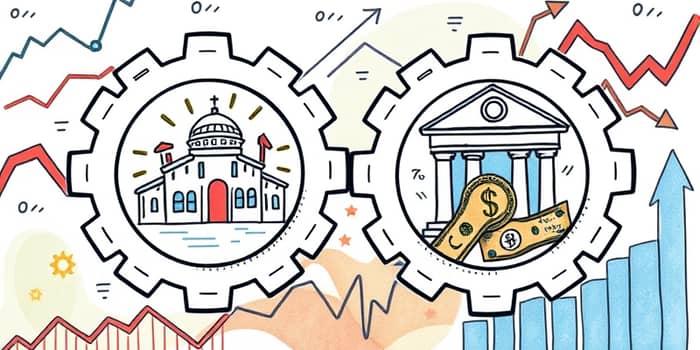
In today's economic world, knowing how fiscal and monetary policies work can unlock insights for better financial decisions.
This article clarifies these key concepts to inspire and empower you.
Understanding the forces behind economic stability is crucial for everyone.
From business owners to everyday savers, these policies shape our financial landscape.
They influence everything from job markets to interest rates on loans.
By mastering their differences, you can navigate economic changes with confidence.
Fiscal policy involves government actions on taxation and spending.
It aims to influence aggregate demand and foster economic growth.
When governments lower taxes, people have more money to spend.
This boosts consumption and can stimulate business activity.
Similarly, increased spending on projects like infrastructure injects funds directly.
These are examples of expansionary fiscal measures that encourage growth.
On the flip side, raising taxes or cutting spending can cool an overheating economy.
This approach is known as contractionary fiscal policy.
It helps manage inflation by reducing overall demand.
Fiscal policy is often slow to implement due to political processes.
Yet, once in place, it can have targeted effects on specific sectors.
Monetary policy is managed by central banks like the Federal Reserve.
It focuses on regulating the money supply and interest rates.
By setting key rates, central banks influence borrowing costs for everyone.
Lower rates make loans cheaper, encouraging investment and spending.
Higher rates can help curb inflation by making borrowing more expensive.
This policy targets price stability and maximum employment as core goals.
Central banks operate independently to avoid political interference.
They use various tools to adjust economic conditions quickly.
For instance, open market operations involve buying or selling securities.
This directly affects the amount of money circulating in the economy.
This table highlights how these policies diverge in approach and execution.
Understanding these distinctions helps in anticipating economic shifts.
Both policies can be expansionary or contractionary based on economic needs.
Expansionary policies aim to boost growth and reduce unemployment.
They increase money flow or government spending into the economy.
This can lead to higher prices but also more job opportunities.
Contractionary policies are used to control inflation.
They involve reducing spending or raising interest rates.
This might slow down growth temporarily to ensure long-term stability.
These effects ripple through markets, affecting everything from stock prices to mortgage rates.
Fiscal and monetary policies often work best when coordinated.
During economic downturns, both can be used to stimulate recovery.
For example, in the 2008 financial crisis, the Fed lowered rates.
Simultaneously, the government passed stimulus bills to inject funds.
This synergy helped stabilize the economy and restore confidence.
However, conflicts can arise if policies are misaligned.
If one is expansionary while the other is contractionary, it may hinder progress.
Effective coordination requires careful monitoring of economic indicators.
Knowledge of these policies can directly benefit your financial planning.
When governments announce tax cuts, you might expect increased disposable income.
This could be a good time to invest or make large purchases.
If central banks raise interest rates, borrowing costs may go up.
This might encourage you to save more or refinance debts early.
Staying informed helps you adapt to changing economic conditions.
These steps empower you to make proactive decisions.
Each policy has its advantages and drawbacks.
Fiscal policy is effective for long-term structural adjustments.
It can target specific industries or social needs directly.
Monetary policy offers quick responses to economic fluctuations.
It helps maintain liquidity and control inflation in the short term.
However, fiscal policy can be slow due to political hurdles.
Monetary policy risks causing inflation if overused.
Both face implementation lags that can delay results.
Understanding these aspects encourages a balanced view.
History shows how these policies shape economies over time.
The U.S. targets 2-3% inflation as a normal range.
Past crises, like 2008, demonstrated the power of coordinated action.
Learning from these events can guide future economic strategies.
Common questions arise about their differences and impacts.
These insights help demystify complex economic concepts.
Embracing an understanding of fiscal and monetary policy transforms how you view the economy.
It inspires confidence in navigating financial uncertainties.
By recognizing the tools for economic stability, you can plan better for the future.
Whether saving for retirement or running a business, this knowledge is invaluable.
Let this clarity empower you to engage with economic news actively.
Remember, these policies are designed to foster a prosperous environment for all.
Use this insight to make informed choices and thrive in any economic climate.
References