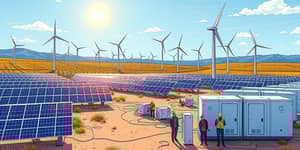
Across the globe, investors, policymakers, and innovators are aligning capital flows with nature’s needs. Regeneration financing leverages the power of markets to restore ecosystems, drive resilience, and unlock new growth frontiers.
In 2026, corporations no longer view environmental stewardship as a cost center. Linking environmental and social performance to project returns has become a corporate norm. Senior executives recognize that nature restoration, water security, and carbon reduction are core to long-term growth and resilience.
Investor surveys reveal that 86% of asset owners plan to increase allocations to climate and biodiversity solutions in the next two years. This reflects a profound shift: regeneration is now a revenue driver, not merely a compliance checkbox.
The rapid proliferation of AI and data centers has boosted global electricity demand by 10% in 2025 alone. To meet this surge responsibly, renewable installations grew over 17% in 2026. Wind, solar, and battery storage dominate new capacity, accounting for 92% of U.S. additions through November 2025.
Meanwhile, investment vehicles targeting renewables overtaking fossil fuels have expanded dramatically. Green bonds for clean energy projects contributed to the €420 billion issued in 2024, fueling solar farms, offshore wind arrays, and grid-scale batteries worldwide.
Mitigation alone no longer suffices. The world faces an escalating need to adapt to intensifying storms, droughts, and heatwaves. Adaptation finance grew from a $1 trillion market in 2025 to a $4 trillion opportunity by 2050.
According to COP30 projections, annual adaptation funding must triple by 2035 to close a $310–365 billion gap in developing economies. Institutions are responding: insurers, pension funds, and multilateral lenders are underwriting flood defenses, resilient agriculture, and climate-smart infrastructure at scale.
Biodiversity loss poses systemic risks to supply chains, food security, and public health. Investors are deploying capital into sustainable agriculture, wetland restoration, and community-led conservation. Initiatives like the Tropical Forest Forever Facility now raise $4 billion annually to protect critical ecosystems in 74 emerging markets.
These efforts are guided by frameworks such as the Taskforce on Nature-related Financial Disclosures (TNFD), helping asset managers quantify dependencies on ecosystem services and integrate nature into corporate decision-making.
Capital is flowing through a diverse toolkit of instruments designed to link financial returns with measurable impacts.
By blending public grants, concessional loans, and private capital, blended finance structures have unlocked projects from clean cookstoves in Africa to mangrove reforestation in Southeast Asia.
Europe continues to lead on climate policy, with EU sustainable debt issuances hitting record highs. The Asia-Pacific region is emerging as a powerhouse for green infrastructure, driven by energy-hungry data centers and an 80% expectation of growth in sustainable assets among regional investors.
Despite shifting policy in the United States, private sector commitments to wind and solar remain strong. Companies are signing long-term offtake agreements for renewable power, ensuring that the U.S. maintains momentum toward peak greenhouse gas emissions by decade’s end.
Rapid electrification and AI-driven demand exert pressure on aging grids and rare earth supply chains. Geopolitical tensions have at times disrupted critical minerals flows, highlighting the need for diversified sourcing and unprecedented demand from data centers.
To navigate these headwinds, investors are enhancing due diligence, incorporating scenario analysis, and partnering with local governments to de-risk large-scale adaptation and nature-based projects.
AI-powered platforms now parse satellite imagery and ESG data to flag ecological stress points, enabling rapid responses to deforestation alerts or water scarcity signals. Advanced geothermal and small modular nuclear reactors are reemerging as complementary clean energy sources in regions with abundant underground heat.
Looking ahead, carbon pricing mechanisms now cover 28% of global emissions, an increase driven by rising corporate commitments to net-zero pathways. The integration of biodiversity metrics into mainstream investment analysis promises to further align capital with planetary boundaries.
By 2030, renewable capacity additions may begin to plateau, shifting focus toward hybrid systems, storage, and grid modernization. Yet the overarching trend is clear: trillions of dollars in opportunities are available for investors who adopt a regeneration mindset and center nature-positive outcomes in their portfolios.
References