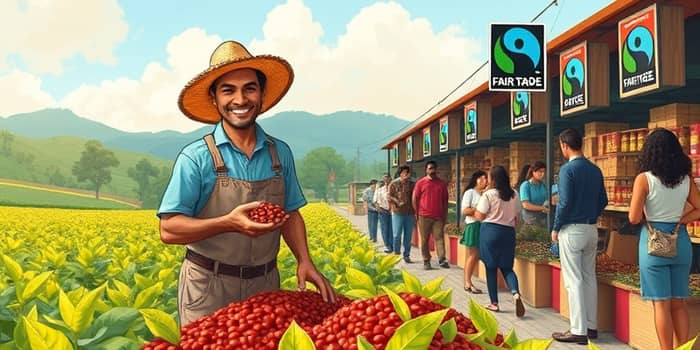
Imagine a world where your daily coffee or chocolate directly supports farmers' dignity and children's education.
This is the promise of fair trade, a movement reshaping global commerce.
Transforming lives across the globe, it bridges the gap between producers and consumers with ethics at its core.
With annual sales exceeding $10 billion, fair trade certified products are no longer a niche.
They represent a burgeoning force for economic justice, touching millions of lives in tangible ways.
Over 2.5 million producers and workers from 70 countries are part of this vibrant ecosystem.
Their stories of empowerment fuel a cycle of sustainable development and hope.
Fair trade's footprint is vast and deeply interconnected.
It spans from small farms in Latin America to markets in Europe and beyond.
Key statistics underscore its scale.
Volunteers, numbering over 100,000, amplify this impact through advocacy.
Together, they build a fairer trading system that prioritizes people over profits.
At the heart of fair trade is financial security for producers.
Farmers, workers, and fishers have earned more than $1 billion in Community Development Funds.
This wealth translates into better schools, clinics, and infrastructure.
Communities thrive on these investments, fostering local resilience.
Research confirms that fair trade provides greater price stability, shielding producers from market volatilities.
Even when prices drop, a minimum price is guaranteed, ensuring a safety net.
The Fairtrade Premium adds extra funds for community projects.
Producers decide how to use this money, empowering local decision-making and autonomy.
In Costa Rica, studies show a 2.2 percent increase in income for farm owners with certification.
This boost is vital for escaping poverty cycles and building sustainable futures.
Fair trade's influence weaves through economic, social, and environmental threads.
It creates resilient communities and sustainable practices for long-term health.
The strongest areas of impact include diverse benefits.
For instance, organic sales represent 59% of fairtrade bananas and 57% of coffee.
This alignment with sustainability goals is profound and impactful.
Fair trade fosters longer-term resilient supply chains.
It encourages practices that protect ecosystems and ensure future productivity.
Fair Trade Certified products are produced under strict guidelines.
120+ social, economic, and environmental protections safeguard well-being across all stages.
These standards cover fair wages, safe working conditions, and bans on child labor.
They also include environmental criteria like water conservation and biodiversity.
This framework ensures that growth does not come at the expense of ethics.
Producers are equipped to meet global demands responsibly and with integrity.
The composition of fair trade products highlights this commitment.
Organic elements are prevalent, as seen in key categories.
This diversity supports sustainable agriculture and consumer choice.
Consumers are increasingly driving the fair trade movement forward.
More than 50% of consumers across 15 countries are aware of certifications like the Fairtrade Mark.
This awareness breeds positive impressions and shifts purchasing habits.
80% of those aware view certified products more favorably, indicating trust.
Key consumer trends highlight a growing ethical consciousness.
Trust plays a crucial role in this dynamic.
Consumers believe that fair trade labels signify integrity and real impact.
Businesses are recognizing the value of fair trade in modern markets.
It aligns with sustainability goals and enhances brand reputation significantly.
Robust monitoring data provided by fair trade systems helps companies track impact.
This transparency builds consumer confidence and fosters loyalty.
Engaging in fair trade can open new market segments and boost sales.
It appeals to ethically conscious consumers, creating a competitive edge.
Companies find that ethical sourcing reduces risks in supply chains.
It ensures stable partnerships and positive community relations over time.
Competition among fair trade certifiers presents both opportunities and challenges.
It brings fair trade products into the mainstream, making them more accessible to consumers.
However, this competition may reduce unit premiums per product.
While more farmers participate, each might receive less on average.
This dynamic requires innovative strategies to maintain fairness.
Ensuring that growth benefits farmers directly is essential to avoid pitfalls.
Placing farmers at the center of policies can mitigate these trade-offs.
Collaborative efforts among certifiers can harmonize standards for better outcomes.
Research solidifies fair trade's credibility and long-term effectiveness.
A 2021-2024 Fairtrade Evidence Map study found strong confidence in improving labour conditions.
Key research insights provide guidance for future initiatives.
This evidence ensures that fair trade remains responsive to real needs.
It guides stakeholders in refining approaches for maximum impact.
Fair trade enterprises excel at spreading benefits throughout value chains.
They involve importers, world shops, and volunteers in creating equitable systems.
This integrated approach ensures that profits are shared fairly among all parties.
It fosters partnerships based on mutual respect and long-term commitment.
The table below summarizes key impacts, illustrating how fair trade financing creates tangible change.
This table highlights the multifaceted benefits of fair trade.
It shows how financial mechanisms drive social and environmental progress globally.
Fair trade financing is a partnership that empowers everyone involved.
By choosing fair trade, you support producers' dignity and sustainable practices directly.
Every purchase is a vote for a fairer world with interconnected communities.
It connects you to global stories in meaningful and impactful ways.
Let's continue to champion this cause together.
Together, we can ensure that trade benefits all, creating a legacy of equity and hope.
References