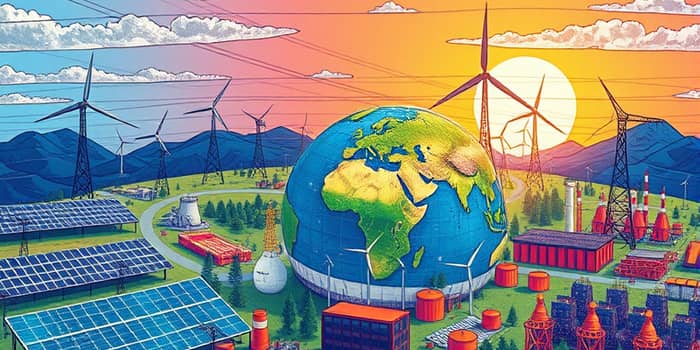
In a world racing toward sustainability and security, energy economics sits at the heart of innovation and resilience. From record capital flows to onshore supply chain strategies, the patterns we set today will define prosperity for decades.
The year 2025 saw record investments driving global transition with $3.3 trillion in total spending, of which $2.2 trillion (67%) targeted clean technologies. Governments and corporations are reshaping portfolios around renewables, electric vehicles, grid upgrades, storage solutions and clean fuels.
This influx reflects a shift toward industrial policy over energy policy, with local-content rules, tax credits and subsidies driving a competitive race to build factories and value chains closer to home.
In an era of volatile supply, nations are diversifying sources, hardening infrastructure and reducing reliance on unstable suppliers. Europe is phasing out Russian gas and oil, while the United States onshores critical minerals like lithium and cobalt. China fortifies its tech and pipeline networks, ensuring that energy flows remain uninterrupted even amid global tensions.
Policy debates now emphasize execution over ambition, competitive advantage and near-term impacts—prioritizing jobs, innovation and tariff relief over distant decarbonization targets.
Renewables continue their ascent. By September 2025, the U.S. added 30.2 GW of new capacity—93% of all power additions—driven by solar (83% of that total) and supported by safe-harbor tax provisions projecting even faster growth in 2026 and 2027.
On public lands, $13 billion in capital costs (in 2019 dollars) delivered substantial rent and royalty revenues. As clean projects multiply, clean energy dominance within national portfolios has shifted from aspiration to reality.
Electricity consumption is projected to climb 30% by 2040—to 5,500 TWh—fueled by data centers, artificial intelligence, manufacturing onshoring and broad electrification. This surge challenges grids and affordability models alike.
Confronting an electricity affordability crisis requires market redesigns, flexible rate structures and strategic dispatch planning to balance renewables variability with gas-fired backup.
Clean energy investments are engines of prosperity. Meta’s support for nearly 9,900 MW of U.S. solar and wind projects across 24 states generated $14.2 billion in development capital. Over a decade, construction phases alone created 74,489 jobs (26,869 direct and 47,000 indirect/induced), contributing $7.8 billion to GDP and $4.4 billion in labor income.
Across the sector, clean energy jobs grew 4.2% in 2023—more than twice the overall energy sector rate—underscoring jobs, GDP and tax revenues as core benefits of this transition.
Despite clean momentum, natural gas demand is poised to rise by 6 bcf/d (2025–2030), with LNG exports up 13.5 bcf/d. Oil markets, buoyed by geopolitical tensions, could enter a multi-year bull cycle, prompting long-cycle investments. Policymakers and operators are thus embracing an All-of-the-Above energy approach to ensure stability and mitigate price shocks.
Rapid growth brings complexity. Rising prices, rate design challenges and export policies risk undermining public support. Regulators and utilities must innovate flexible tariff models, demand-response programs and cross-regional trading frameworks to maintain reliability without overburdening consumers.
Balancing rising prices and policy complexity will define which jurisdictions attract capital and which lag behind.
2026 marks a high-stakes execution test. Countries and companies compete on cost, speed and local benefits rather than moral posturing. The U.S. dominated 93% of renewables additions in 2025, while Meta’s projects spread gains far beyond host states. On public lands, blended revenue streams for communities showcase the power of pairing environmental stewardship with economic renewal.
Researchers forecast wholesale power prices could fall 20–80% in key regions by 2040 as clean technologies scale, wages rise modestly and efficiency improves. Yet emphasis now shifts to reduced emphasis on net-zero rhetoric in favor of tangible local wins.
Ultimately, energy economics in 2026 is about forging resilient systems that deliver jobs, security and sustainability—transforming markets today while laying the foundation for a cleaner, more prosperous tomorrow.
References