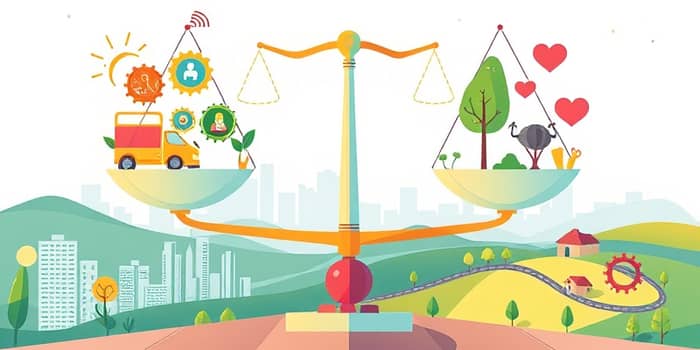
In an ever-evolving global landscape, economic growth stands as a beacon of progress, shaping nations and improving lives through increased production of goods and services. It is not just a statistical measure but a vital force that fuels innovation, creates jobs, and elevates living standards, making its study essential for policymakers, businesses, and individuals alike.
This article delves into the intricacies of economic growth, exploring its drivers, confronting its limits, and navigating the delicate trade-offs that define sustainable development. By understanding these elements, we can harness growth for broader societal benefits, moving beyond mere numbers to create meaningful change.
At its core, economic growth reflects an expansion of a country's output, often measured by Gross Domestic Product (GDP), which serves as a key indicator of economic health. However, this quantitative focus must be balanced with qualitative insights to ensure growth translates into real improvements for people.
Economic growth is fundamentally defined as an increase in the production of goods and services over time, typically gauged through metrics like GDP. This measure captures the total economic activity within a nation, offering a snapshot of its performance.
To grasp its nuances, we must distinguish between nominal and real GDP, as inflation can distort perceptions. Real GDP adjusts for price changes, providing a clearer picture of true economic progress and helping avoid misleading signals about prosperity.
These indicators are vital tools, but they come with challenges, such as measuring service sectors accurately or addressing jobless recoveries where growth outpaces employment.
Sustained economic growth relies on a blend of factors that work synergistically to boost productivity and output. Research identifies three main long-run drivers: capital accumulation, labor inputs, and technological advancement.
Technological progress is the primary catalyst for long-term growth, as it overcomes diminishing returns from capital and labor alone. By fostering innovation, economies can achieve higher efficiency and competitiveness.
Empirical studies show that factors like energy use and trade have positive impacts, but short-run effects can vary, highlighting the need for balanced strategies.
Despite its potential, economic growth faces significant constraints that can stifle progress if not addressed. Factors such as political instability or poor education can undermine development, limiting a nation's ability to thrive.
The law of diminishing returns poses a key challenge, as unlimited growth through capital accumulation alone is unsustainable. This underscores why technological innovation is essential for breaking through these barriers.
Measurement issues, like accounting for technical progress or service sector output, add complexity, requiring refined approaches to accurately assess growth.
Economic growth must be viewed in contrast to economic development, which encompasses broader societal well-being. This distinction is critical for ensuring that growth translates into improved lives, not just increased output.
This table highlights how growth and development differ, emphasizing that sustainable development requires balancing economic expansion with social and environmental goals.
By focusing on these aspects, policymakers can foster qualitative growth that benefits everyone, not just the economy.
To achieve continuous growth, effective policies must address both drivers and constraints, promoting innovation and inclusivity. Insights from research suggest tailored approaches for different contexts, from advanced to developing economies.
Policymakers should prioritize human capital development and technological investment to unlock long-term potential. Encouraging labor force participation through education and training can further amplify growth.
Countries with advanced economies often excel by focusing on technology and skills, while developing nations must avoid over-reliance on natural resources without investing in innovation.
In conclusion, economic growth is a powerful tool for progress, but it demands a nuanced understanding of its drivers, limits, and trade-offs. By embracing a holistic approach that balances quantitative measures with qualitative development, we can build economies that are not only prosperous but also equitable and sustainable. Let this knowledge inspire action towards a future where growth serves humanity in all its dimensions.
References