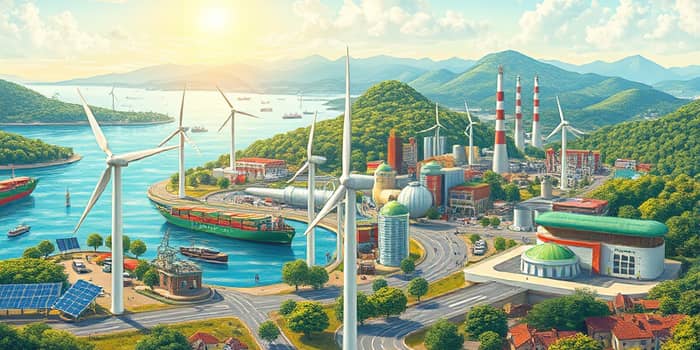
As the world stands at a crossroads in our climate journey, 2026 emerges as a beacon of transformation. With global leaders aligning around pivotal year for policy implementation, we witness a surge of ambition and commitment. This article delves into the strategies, investments, and innovations propelling us toward a resilient, low-carbon economy, offering guidance to investors, policymakers, and communities ready to embrace change.
In 2026, policy landscapes will undergo seismic shifts. Europe’s carbon border adjustment mechanism and phaseout of free allowances signal a new era of carbon accountability and transparency. Meanwhile, China’s first emissions cap and Japan’s GXETS launch underscore Asia’s growing momentum. The United States, after rejoining global climate accords, adopts a project-driven approach that balances ambition with realism, creating dynamic demand signals for clean energy investment.
Despite geopolitical fragmentation—where the U.S. emphasizes AI over renewables, China prioritizes energy security with industrial growth, and Europe accelerates electrification—a convergence emerges in renewables capacity. Investment in wind, solar, and storage is forecast to double by 2030, driven by industrial policies and tariffs that reshape supply chains in batteries, EVs, and critical minerals. This alignment demonstrates the power of shared purpose amidst geopolitical tensions and volatility.
To achieve net-zero by mid-century, we must address sectors historically resistant to decarbonization. Shipping, steel, cement, aviation, and trucking represent both our greatest challenges and opportunities for innovation. By combining policy incentives with technological breakthroughs, these industries can slash emissions and thrive in a low-carbon marketplace.
Complementing these pathways, carbon removal and bridge technologies such as bioenergy with carbon capture, direct air capture, and enhanced weathering will be pivotal. Major corporations like Microsoft and Google have contracted over six million tonnes of removal credits, channeling billions into natural capital projects. These bridges help transition hard-to-abate emissions while nascent solutions mature.
Investors have a once-in-a-generation opportunity to finance transformation. Annual clean energy investment, currently at USD 2 trillion, must double within a decade to meet IEA net-zero scenarios. From green bonds to climate-focused ETFs, capital flows can unlock lasting returns and societal benefits, fueling innovation across sectors.
Below is a snapshot of key investment categories and their potential impacts:
Three primary investment approaches guide capital allocation and tie finance directly to emission reductions:
Parallel to these trends, the voluntary carbon markets are expanding rapidly, growing from USD 2 billion today to a projected USD 100 billion by 2030. Impact investors tapping into enhanced weathering, BECCS, and natural capital credits can optimize portfolios for both financial returns and measurable environmental and financial outcomes.
Policy and diplomacy will define the success of decarbonization. The EU’s decarbonization bank aims to mobilize public and private capital through guarantees and low-cost loans. Asia’s emerging emissions pricing schemes, coupled with U.S. tax credits for carbon capture, can accelerate deployment. Harmonized frameworks reduce risk and amplify impact, creating harmonized policies and blended finance that benefit all stakeholders.
Frontier solutions offer hope for bridging the remaining 35% of required emission cuts. Advances in biomethanol, bio-LNG, and novel cement chemistries are piloting at scale. Electrochemical processes and direct air capture hubs are moving from demonstration to commercial viability, aided by breakthrough funding models and demand guarantees from the First Movers Coalition.
Critical mineral reshoring—lithium, cobalt, nickel, rare earths, and copper—ensures stable supply for batteries and renewables. By investing in these value chains now, we can secure both economic opportunity and environmental integrity for decades to come.
Decarbonization is not a solitary endeavor but a collective journey. Governments, corporations, investors, and civil society must unite around shared purpose-driven investment and policy goals. Each capital allocation, regulatory reform, and technological deployment draws us closer to a world where prosperity is decoupled from emissions.
As individuals, we can channel savings into green funds, advocate for resilient urban planning, and support businesses driving sustainable innovation. Together, we can transform ambition into impact, ensuring that future generations inherit a thriving planet rather than a climate crisis.
Let us embrace the monumental opportunity before us. By weaving policy, technology, and finance into a coherent tapestry of action, we can forge a low-carbon economy that benefits all. The decisions we make today will resonate for centuries—an enduring testament to our collective courage and creativity.
References