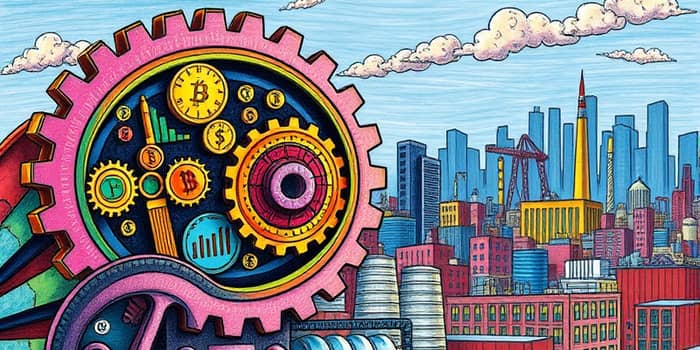
In the intricate web of global finance, credit markets stand as the fundamental engine that drives economic progress.
As we approach 2026, these markets are projected to remain resilient amidst challenges, underpinning sustained growth and investment.
This resilience is crucial for supporting U.S. economic growth at 2% or slightly above, a trend bolstered by shifting monetary policies.
Understanding how credit markets function can empower stakeholders to make informed decisions in an evolving landscape.
This article delves into the mechanisms, forecasts, and risks, offering a comprehensive guide to navigating the future of credit.
Global credit conditions are expected to hold firm in 2026, with economic growth maintaining momentum.
The U.S. economy is anticipated to grow at or near its long-term trend, supported by Federal Reserve actions.
This represents a shift from the restrictive monetary environment of recent years.
Credit markets will play a pivotal role in this stability, acting as a bridge for corporate and consumer financing.
Their performance is closely tied to broader macroeconomic trends and policy decisions.
Several key factors influence credit market dynamics, starting with monetary policy.
The Federal Reserve is likely to continue cutting interest rates, reducing business costs and stimulating the money supply.
Inflation is stabilizing, with forecasts around 3.2% in 2026, easing pressure on borrowers.
Fiscal policy faces constraints due to rising federal debt, which may limit government flexibility.
These drivers collectively shape the credit environment, affecting everything from bond yields to loan availability.
Lower oil prices and softer rental markets contribute to disinflationary pressures.
This creates a more favorable backdrop for credit expansion and economic activity.
Investment grade bond supply is set to surge, with forecasts of $2.25 trillion in gross issuance.
This increase is driven by robust corporate spending on AI and capital investments.
Despite this, credit spreads are expected to see only modest widening of 15 basis points.
Private credit continues to grow, offering alternative financing options but with associated risks.
The divergence between equities and credit markets may mirror historical templates, with equities outperforming.
Persistent demand from yield-focused investors should help anchor spreads near historical lows.
This dynamic underscores the engine-like role of credit in facilitating corporate expansion and innovation.
Loan growth is poised to accelerate as interest rates decline, benefiting corporate borrowers.
Commercial and industrial lending, which dropped in early 2025, is expected to reverse its trend.
Consumer credit dynamics show household debt peaking, with sentiment testing spending habits.
Credit card loan growth may stabilize after recent declines, reflecting tightened lending standards.
Commercial real estate markets are recovering, with property sales activity on the rise.
Credit quality remains manageable, with banks holding sufficient reserves for potential losses.
This sectoral analysis highlights how credit permeates all aspects of economic life.
Political polarization is reshaping global governance, increasing unpredictability and credit risks.
Digital finance innovations, like stablecoins, expand access but introduce new vulnerabilities.
Climate-related credit risk is rising, with economic losses from extreme weather events.
Adaptation spending needs are significant, especially in emerging markets.
These factors require vigilant monitoring to safeguard credit market stability.
Market-based instruments, such as catastrophe bonds, offer partial solutions to climate risks.
Embracing innovation while managing associated perils is key to sustained growth.
A K-shaped economy is emerging, where high-income households thrive while others struggle.
Elevated inflation hits lower earners hardest, leading to higher delinquencies among them.
Credit risk remains elevated for loans to low- and middle-income borrowers.
Wage growth is unlikely to accelerate enough to alleviate affordability issues.
This divergence underscores the need for targeted credit policies and risk management.
Addressing income inequality can help stabilize credit markets and broader economic health.
Weaker-than-expected growth poses the biggest threat to credit performance.
Rising unemployment rates could signal deteriorating economic conditions.
Corporate risk-taking may increase, challenging lenders with more aggressive borrowing.
Policy constraints from high debt levels limit central bankers' flexibility.
Structural supply constraints in housing and labor could drive persistent inflation.
Historically, periods of growth deterioration during Fed cuts have seen poor credit performance.
Staying alert to these risks enables proactive strategies for investors and institutions.
Credit markets, as the engine of activity, require careful stewardship to avoid stalling.
By understanding drivers and risks, stakeholders can harness credit's power for sustainable progress.
The future holds promise, but vigilance and adaptation are essential for navigating uncertainties.
References