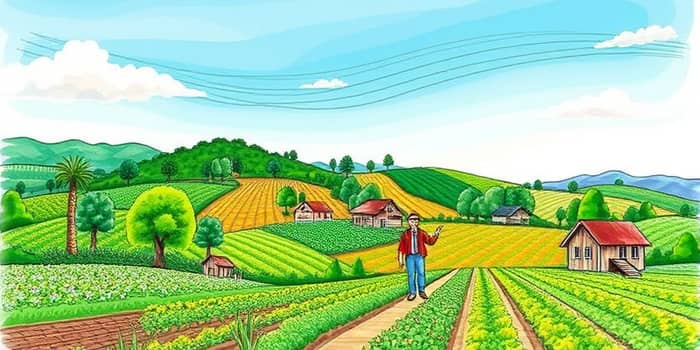
In an era of escalating climate crises and global hunger, a transformative approach is reshaping agriculture from the ground up.
Climate-Smart Agriculture (CSA) offers a powerful solution that tackles these intertwined challenges head-on, fostering resilience and prosperity.
It represents a holistic framework that achieves a triple win strategy for our planet and its people, making it a cornerstone of sustainable development.
At its core, CSA is designed to deliver three critical outcomes simultaneously, ensuring a balanced and forward-thinking agricultural system.
First, it aims to sustainably increase agricultural productivity and incomes, directly supporting the livelihoods of millions who depend on farming.
This is crucial for rural communities, where agriculture remains the primary source of employment and food.
Second, CSA enhances resilience and adaptation to climate risks such as droughts, floods, and erratic weather patterns.
By fortifying infrastructure and reducing vulnerability, it helps farmers withstand environmental shocks that threaten food supplies.
Third, it focuses on reducing or removing greenhouse gas emissions, addressing agriculture's significant contribution to climate change.
Through practices like carbon sequestration and improved resource management, CSA mitigates impacts while promoting ecological health.
This integrated approach builds on existing methods but steers them toward greater efficiency and sustainability, emphasizing local contexts for maximum impact.
CSA encompasses a diverse array of site-specific practices and technologies that optimize resource use and enhance sustainability.
These methods are tailored to local conditions, ensuring they are both effective and adaptable.
These practices not only stabilize yields under extreme conditions but also protect vital ecosystems, creating a more robust agricultural foundation.
The benefits of CSA are profound, spanning environmental, economic, and social dimensions that directly fund food security and sustainability.
By optimizing inputs such as water and fertilizers, CSA boosts productivity and profitability, making farming more viable for smallholders.
This leads to higher yields and improved food access, especially in vulnerable regions where climate shocks are frequent.
CSA enhances resilience to shocks like droughts and floods, reducing price volatility and ensuring stable food supplies.
It also contributes to sustainability by cutting greenhouse gas emissions and conserving soil, water, and biodiversity.
For livelihoods, CSA boosts incomes and prepares communities for disasters, scaling through partnerships and innovations.
Agent-based models confirm that CSA adopters often experience higher food security than non-adopters, underscoring its practical impact.
This table highlights how CSA delivers tangible results across multiple fronts, reinforcing its role as a comprehensive solution.
Moreover, CSA practices like integrated pest management reduce chemical use, promoting healthier ecosystems and communities.
Together, these benefits create a virtuous cycle of sustainability and resilience that is essential for global food security.
Across the globe, CSA initiatives are demonstrating remarkable success, transforming lives and landscapes through innovative applications.
These stories inspire hope and provide blueprints for scaling sustainable practices in diverse contexts.
These examples illustrate how CSA adapts to local needs, leveraging technology and traditional knowledge for maximum effect.
Partnerships with ministries and banks further drive adoption, providing the necessary financing and policy support for widespread implementation.
Such collaborations highlight the importance of integrated systems in achieving sustainable outcomes.
Despite its potential, CSA faces significant barriers that hinder widespread adoption, particularly among smallholder farmers in resource-limited settings.
Addressing these challenges is crucial for unlocking CSA's full benefits and ensuring equitable access.
By tackling these barriers head-on, we can scale CSA to benefit millions, turning challenges into opportunities for growth and sustainability.
As climate change intensifies, threatening agricultural production and food security worldwide, CSA stands as a critical response to this existential challenge.
It protects hundreds of millions of smallholders, preserves ecosystems, and ensures global food supplies remain stable in the face of uncertainty.
Organizations like the World Bank, FAO, and USDA emphasize CSA's role in sustainable development, advocating for its integration into national policies and international agendas.
This global imperative calls for more than just technological fixes; it requires holistic systems that blend innovation with tradition, policy with practice.
By embracing CSA, we can fund a future where food security and sustainability go hand in hand, creating a resilient world for generations to come.
Let us champion this vision, turning hope into action and cultivating a brighter, more sustainable tomorrow through climate-smart agriculture.
References