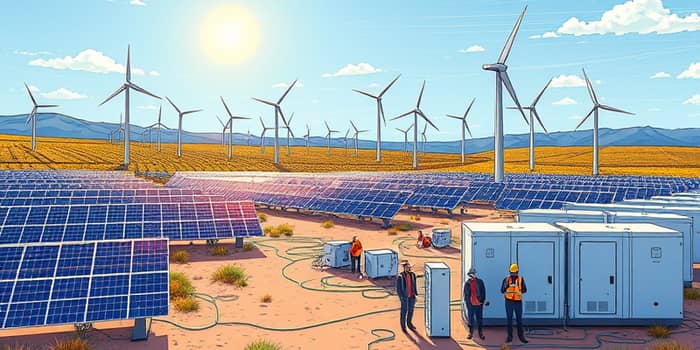
In 2025, the clean technology sector sits at a critical juncture. Global investments are soaring to historic highs even as venture capital for early-stage startups contracts dramatically. This article navigates the complexities of the funding landscape, spotlights cutting-edge technologies, and outlines pragmatic strategies for innovators, investors, and policymakers determined to drive the next wave of sustainable solutions toward market success.
The cleantech sector is on track for unprecedented funding. Experts have forecasted to hit nearly $670 billion in 2025, marking the first time that sustainable energy outpaces fossil fuel spending globally. In the United States alone, clean energy and transportation investments reached a record-high of $75 billion in Q3 2025, reflecting an 8-9% year-on-year increase.
Yet this broad growth conceals a troubling reality: funding for startups in sustainability-related categories is down 46% from last year. Early-stage companies face dwindling support, raising urgent questions about how tomorrow’s climate champions will bridge the gap between innovation and commercialization.
Early-stage investors are retrenching, leading to an early-stage funding collapse threatens future breakthroughs. Series A and B rounds have shrunk to approximately $3.2 billion, half of the prior year’s levels. As a result, the notorious “Valley of death” between ideation and scale has never been more perilous for emerging entrepreneurs.
Still, later-stage deals show resilience. Companies like Helion Energy secured a $425 million Series F, and Silicon Ranch raised $500 million, illustrating that proven models with solid traction can still attract substantial capital amid tighter conditions.
Solar photovoltaic (PV) technologies dominate this year’s investment roster. Analysts anticipate that renewable capacity needs to triple by 2030 to meet climate targets, with solar PV expected to capture half of all cleantech funding and two-thirds of new installed capacity. Utility-scale announcements surpassed $20 billion in Q3 2025, predominantly in solar and storage projects.
Battery and long-duration energy storage installations are poised to double in 2025, driven by declining costs and maturation of supply chains. However, some major manufacturing plans have been shelved due to rising material prices and shifting policy incentives.
Meanwhile, AI-driven analytics and digitalization are rapidly transforming how utilities forecast demand, optimize grid operations, and manage risk. Data centers represent a significant emerging market, with AI-related power consumption projected to climb by 160% through 2030, propelling further clean energy adoption.
Capital allocation is consolidating around later-stage companies, with large, more deliberate funding rounds growing by an average of 35%. Investors are favoring proven business models over multiple high-risk bets, reflecting a more cautious appetite for cleantech ventures.
To fill emerging gaps, innovators are leveraging hybrid debt/equity frameworks and grants and blended-finance structures. These creative vehicles enable first-of-a-kind projects to secure the mix of grants, subsidized loans, and private capital necessary to reach operational milestones.
National priorities profoundly shape the funding climate. In the U.S., reductions in Department of Energy grants for carbon capture and clean energy demonstration projects have forced startups to seek alternative capital sources or pivot their strategies. North America, however, maintains leadership in corporate procurement, boosting off-take agreements for clean power.
In Canada, federal procurement targets rising to 5% of government spending by 2025 have stimulated domestic cleantech growth, even as VC deployments lag behind last year’s pace. Europe continues to invest in first-of-a-kind renewable production facilities, supported by state-backed guarantees and green bonds.
Strengthening public-private partnerships is vital. By aligning government agencies, institutional investors, and corporations, funding consortia can pool resources to support high-potential startups. Establishing innovation funds and challenge prizes encourages creative solutions and drives collaboration across sectors.
De-risking early-stage ventures through milestone-based grants, convertible note programs, and guarantee schemes can sustain the pipeline of new technologies. Partnering with venture studios and incubators also provides critical operational support, mentoring, and market access for fledgling teams.
Global cooperation on climate finance platforms and cross-border investment funds can amplify impact. By sharing best practices, co-investing in strategic regions, and harmonizing regulatory frameworks, the international community can mobilize the capital needed to scale cleantech innovations effectively.
Despite current contractions in certain funding channels, the long-term outlook for clean technology remains robust. Indicators such as rising power demand and climate risks underscore an enduring need for scalable solutions. Record investment shares in Q3 2025 highlight an unprecedented commitment to sustainable infrastructure.
Now is the moment for innovators, investors, and policymakers to unite around a shared mission: accelerating the commercialization of breakthrough technologies, expanding renewable capacity, and championing policies that incentivize sustainable growth. Through collective action and unwavering determination, we can power the clean energy transition and safeguard the planet for future generations.
References