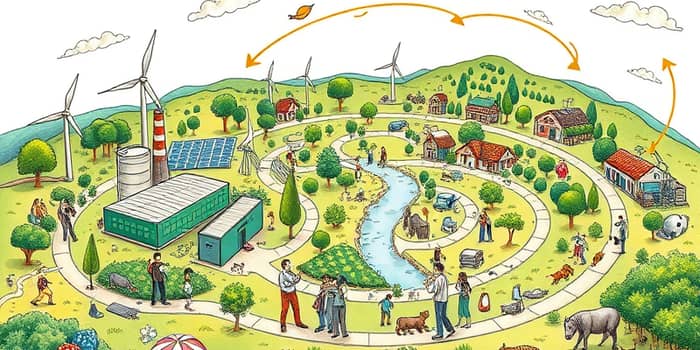
The global economy is at a crossroads. A transition from the traditional linear “take, make, dispose” model to a regenerative, circular system offers a path to sustainable prosperity. By redefining how we design, use, and finance products, we can build resilient communities and protect our planet.
In this article, we explore the principles, benefits, and strategies that underpin the circular economy. We highlight real-world examples, financial opportunities, and practical steps for businesses and consumers alike.
The circular economy is a systemic approach that seeks to eliminate waste and pollution by keeping products and materials in continuous use. Unlike a linear model focused on extraction and disposal, the circular model draws inspiration from natural ecosystems, where nothing is wasted and everything is repurposed.
First conceptualized in the 1970s, the circular economy gained prominence through frameworks such as the Ellen MacArthur Foundation’s principles and the European Union’s resource strategies. Today, it stands as a beacon for sustainable production and consumption worldwide.
Building upon these core principles, the circular economy encompasses seven key pillars:
From industrial complexes to small businesses, organizations worldwide are embedding circular strategies into operations. These pioneering projects demonstrate how resource loops can generate both environmental and economic gains.
Industrial Symbiosis in Denmark: The “Sustainable Synergies” initiative in Aalborg brings together 25 companies to exchange residual materials, water, and energy. Participants report significant cost reductions in waste management and procurement, while forging new revenue streams through joint innovations.
These examples illustrate how industrial collaboration and technology can maximize resource value and reduce environmental burdens. They also highlight the importance of cross-sector partnerships and innovation in scaling circular solutions.
Adopting circular strategies unlocks multiple financial advantages. Companies reduce raw material costs by sourcing secondary inputs through recycling and reuse. Extended product lifecycles diminish procurement expenses and lower maintenance outlays over time.
Furthermore, new business models such as product-as-a-service create recurring revenue streams. Clients pay for access rather than ownership, incentivizing providers to deliver durable, upgradable offerings that align with long-term profitability and sustainability.
Investors and financial institutions are increasingly recognizing the value of circular ventures. Dedicated green bonds and sustainability-linked loans reward organizations that meet circular performance criteria, leading to lower financing costs and improved credit ratings.
Transitioning to a circular economy requires a comprehensive approach, from design to end-of-life management. The following strategies can guide organizations and communities:
By embedding these strategies into core operations, businesses can build resilience against resource scarcity and price volatility. Consumers, meanwhile, benefit from higher-quality products and flexible usage models.
Quantifying circular performance is essential for continuous improvement and transparency. Key metrics include:
Digital tools such as lifecycle assessment (LCA) software and blockchain-based tracking can enhance traceability and validate circular claims. These insights empower stakeholders to make data-driven decisions and allocate resources effectively.
The circular economy offers a transformative blueprint for sustainable growth. By redesigning systems to eliminate waste, recirculate materials, and restore natural capital, we can foster economic resilience and environmental stewardship.
Governments, businesses, and civil society must collaborate to remove regulatory barriers, incentivize innovation, and share best practices. Education and awareness campaigns can equip consumers to favor circular products and participate in take-back schemes.
Together, we have the opportunity to finance the future of resources, ensuring that every material asset remains in productive use for generations to come. Embracing the circular economy is not just a choice—it is an imperative for a thriving, equitable, and sustainable world.
References